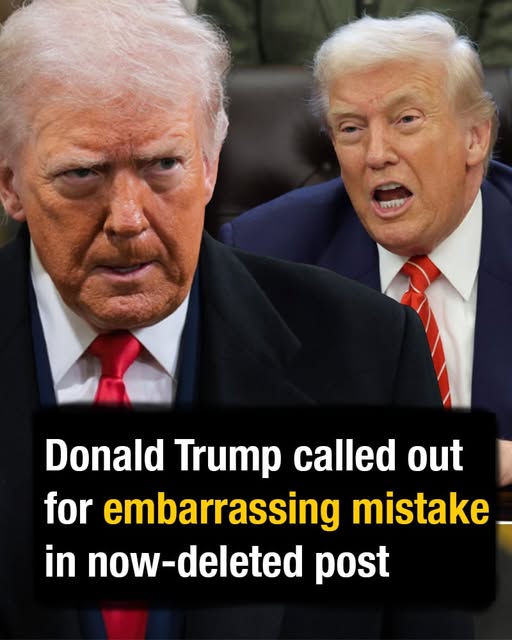
Tensions were already stretched to a breaking point. Headlines pulsed with the possibility of conflict, analysts dissected every movement, and the world seemed to be holding its breath. Then, without warning, Donald Trump hit “post.”
What followed didn’t calm the moment—it sharpened it.
In the middle of a potential military standoff with Iran, Trump published a message on Truth Social that immediately drew attention—not just for its content, but for its tone. The statement, rushed and riddled with awkward phrasing, carried the weight of global consequence but read like something written in haste. Within minutes, observers began to question not just what it said, but how it had been written at all.
This wasn’t an ordinary post. Every word landed in a moment where precision mattered. Trump claimed that the United States and Iran had engaged in “very good and productive conversations,” a surprising note of optimism amid rising tensions. More strikingly, he stated that he had ordered what he called the “Department of War” to delay potential strikes on Iranian power infrastructure—a phrase that alone set off alarm bells among critics and analysts alike.
But it wasn’t just the substance—it was the delivery.
Readers quickly zoomed in on the details: “I am please to report,” one line read, the missing “d” turning a critical update into something oddly careless. Elsewhere, the misuse of “witch” instead of “which” became a lightning rod, a small error that seemed to symbolize something larger. In a moment demanding clarity and control, the message felt unpolished, almost frantic.
And then, just as quickly as it appeared, it vanished.
The original post was deleted. A revised version—cleaner, corrected, more composed—took its place. But by then, it was too late. Screenshots of the first message had already spread across platforms, dissected in real time, amplified far beyond the reach of any edit. In the digital age, nothing truly disappears—especially not something posted at the edge of a global crisis.
The reaction was immediate and divided. Supporters brushed off the errors as insignificant, focusing instead on the substance of delaying military action. Critics, however, saw something more troubling: a glimpse into decision-making under pressure, where even communication appeared impulsive and unfiltered.
In the end, it wasn’t the threat of airstrikes that dominated the conversation that day.
It was the image of a leader at a keyboard, in a moment where the world was watching—and what his words, flawed and fleeting, seemed to reveal about the chaos behind the scenes.