Ventura didn’t hesitate—not even for a second.
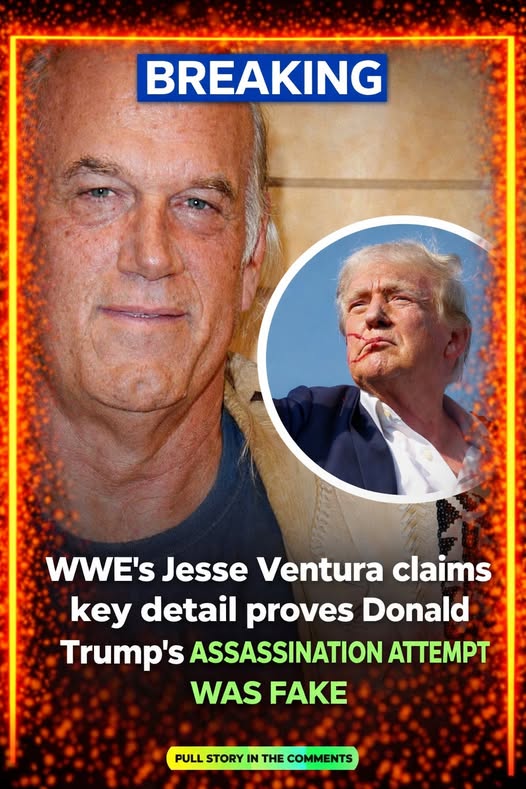
Under the harsh studio lights of a live broadcast, the former wrestling star turned political figure leaned into a moment that instantly shifted the tone of the entire conversation. Facing Piers Morgan across the desk, Jesse Ventura made a claim so explosive it seemed to hang in the air before anyone even had time to react: he suggested that the reported assassination attempt on Donald Trump might not have been what it appeared to be.
A “blade job,” he called it. Wrestling slang. A staged cut. A performance meant to draw blood on cue.
The words landed heavily. Morgan pushed back immediately, challenging the implication, pressing Ventura to clarify how such a claim could be justified. But Ventura didn’t retreat. Instead, he doubled down, sharpening his argument with a question that cut straight through the tension in the studio: “Where’s his scar today?”
For a moment, the room seemed to tighten. The kind of silence that follows a statement too volatile to easily contain. This wasn’t just a disagreement anymore—it had become a collision between perception, politics, and provocation.
Ventura’s framing drew directly from his wrestling background, where “blade jobs” are a known theatrical technique used to simulate real injury. By invoking that language, he blurred the already fragile boundary between performance and reality, suggesting that a moment widely discussed in political and media circles might have been orchestrated for maximum dramatic effect rather than being an authentic act of violence.
Morgan, attempting to anchor the conversation back to verifiable facts, reminded viewers that the incident in question had real-world consequences, including the death of a volunteer fire chief at the rally site. But Ventura appeared unmoved by the correction, continuing to cast doubt and refusing to soften his stance.
At one point, he went further, dismissing the notion of framing individuals involved as heroic figures and instead characterizing Trump in combative terms—someone who “starts the fight and then holds your coat.” It was a phrase designed not just to criticize, but to reframe the entire narrative around intent, victimhood, and spectacle.
As the exchange unfolded, what might have remained a provocative opinion inside a studio rapidly expanded into something far larger outside of it.
Clips of the interview spread across social media within minutes. Edits, captions, and fragmented excerpts began circulating in parallel streams—some amplifying Ventura’s skepticism, others condemning it outright. Fact-checkers and commentators rushed to respond, attempting to separate speculation from established reporting, but the momentum of the moment was already outpacing clarification.
In the digital ecosystem, where outrage travels faster than context, Ventura’s remarks became part of a much broader storm: a clash of narratives where political violence, media distrust, and internet skepticism collide with little friction and even less agreement on what is real.
What began as a studio interview ended as another flashpoint in a deeply fractured information landscape—one where even events described in stark, physical terms can be reinterpreted, repackaged, and relitigated in real time.