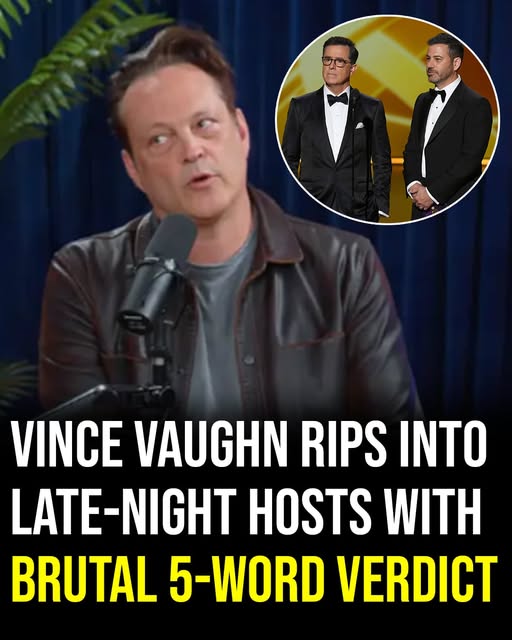
Late-night television is struggling, and Vince Vaughn just said out loud what many in the industry only hint at behind closed doors.
In a blunt, no-frills critique, the Hollywood actor took aim at today’s late-night landscape, arguing that it has drifted far from its original purpose. Without naming names directly, his comments clearly pointed toward the current crop of hosts and shows—figures like Jimmy Kimmel and Stephen Colbert—and what he described as a growing shift from comedy to commentary. According to Vaughn, what once felt like an escape at the end of the day now often feels more like a lecture you didn’t sign up for.
Speaking on Theo Von’s podcast, Vaughn didn’t deliver his thoughts like a polished industry talking point. Instead, he painted a picture that was raw, conversational, and slightly uncomfortable for anyone invested in the traditional late-night format. He described a space that, in his view, has gradually transformed from a place of spontaneity and humor into something more structured, more ideological—almost like a classroom where the audience is expected to nod along rather than laugh freely.
And in that transformation, he suggests, something essential was lost.
Vaughn’s critique lands with weight precisely because it doesn’t come from the outside looking in. He’s spent decades inside Hollywood’s comedy machine—working in films, navigating studios, and witnessing firsthand how entertainment evolves under cultural pressure. Yet he positions himself outside the usual partisan lines, refusing to fully align with either side of the political spectrum. That distance, he implies, gives him a clearer view of what audiences are actually responding to—and what they’re quietly walking away from.
According to him, viewers aren’t necessarily rejecting humor itself. They’re rejecting what he sees as the increasing sense of instruction embedded within it. Instead of being invited to laugh, audiences are sometimes being told what is acceptable to think, what is correct to believe, and which perspectives deserve approval. And for Vaughn, that shift is exactly where the connection between performer and audience begins to fracture.
He contrasts this with the growing popularity of long-form conversations and podcast culture, where dialogue unfolds without strict formatting, punchlines don’t need approval from a writing room, and opinions aren’t constantly filtered through network expectations. In those spaces, he argues, authenticity still has room to breathe. People can disagree without being dismissed, joke without being judged, and explore ideas without immediately being sorted into opposing camps.
Vaughn also acknowledges something more personal in his perspective: his own views aren’t neatly packaged either. They’re, as he describes them, “mixed and messy”—and he sees that complexity as far more representative of everyday audiences than the simplified binaries often presented on mainstream platforms.
That, ultimately, is the heart of his argument. Most viewers aren’t looking to be instructed, corrected, or categorized. They’re looking to feel included. They want entertainment that doesn’t assume their beliefs before the joke is even delivered, and they want spaces where laughter doesn’t come with conditions attached.
For Vaughn, authenticity isn’t just a trend or a talking point—it’s the last remaining currency that still matters in entertainment. And in his view, whether late-night television can reclaim it may determine whether audiences stay… or keep drifting away for good.