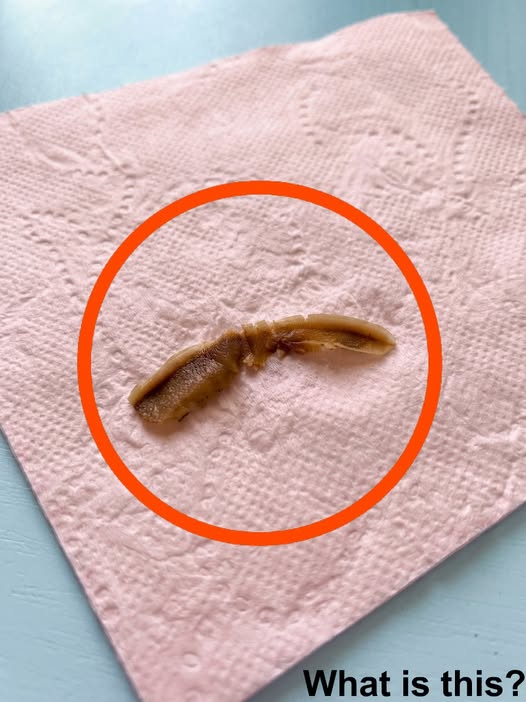
At first glance, it looked disturbingly alive—almost as if it had decided to exist there on purpose. A thin, translucent, layered patch clung stubbornly to the surface, pressed flat like something that had quietly grown overnight while no one was watching. Its edges were uneven and faintly curled, catching the light in a way that made it seem both delicate and wrong. My thoughts immediately spiraled in the worst direction: fungus. Parasites. Some kind of hidden infestation spreading just beyond what I could see.
I scanned the room quickly, almost instinctively, my heart picking up speed. I expected to find more of it—clusters, trails, signs of something multiplying in the corners or creeping along the edges. But there was nothing. No spread, no supporting evidence, no damp patches or discoloration on the walls. Just that single, unsettling fragment, sitting there with quiet confidence, as if it belonged. And somehow, that made it worse.
I kept coming back to it, unable to ignore it. Each time I looked, it seemed to shift in my imagination—its texture too irregular to be simple dust, too structured to be random debris. It was flimsy, yes, but stubbornly adhered, like something organic that had once been alive: a shed membrane, dried skin, or some forgotten biological residue. My mind refused to settle on a reasonable explanation. Instead, it offered a steady stream of increasingly uncomfortable possibilities, each one more dramatic than the last.
Minutes passed like that—me circling the object mentally as much as physically, trying to decode what I was seeing. No mold anywhere else. No moisture. No smell. Just silence and this strange, paper-thin enigma clinging to an otherwise ordinary surface. The uncertainty fed itself, and curiosity slowly began to outweigh hesitation.
Finally, I reached out and carefully lifted the edge.
It gave way far too easily.
There was no resistance, no organic stretch or hidden movement—just a dry, brittle lift, like peeling a fragile chip from a plate. Beneath it was nothing unusual at all: a completely clean, unmarked surface, exactly as it should be. The illusion collapsed in an instant.
Later, after a bit of searching and comparison with reference images, everything became almost laughably clear. What I had been building into a mystery, even a threat, was nothing more than a dried fragment of food—most likely a thin piece of vegetable or fruit peel that had landed there unnoticed and slowly desiccated into something unrecognizable over time.
All that tension. All that imagining of worst-case scenarios. Reduced to something that once belonged in a kitchen, not a horror story.