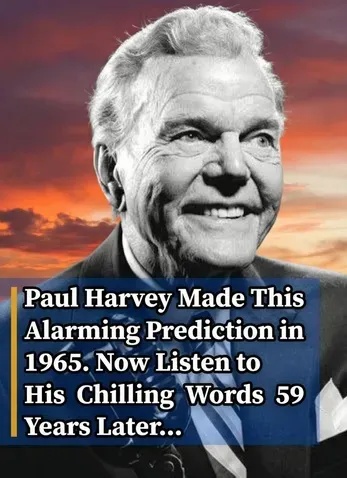
A calm voice cut through the static—and in that quiet moment, it didn’t just deliver commentary, it planted a slow-burning warning that would echo for decades.
In 1965, a renowned American commentator delivered a monologue that unsettled many who heard it. It wasn’t loud or sensational. There were no dramatic visuals or urgent headlines—just carefully chosen words, spoken with restraint, describing a future that felt strangely distant at the time. He painted a picture of a society drifting toward comfort without reflection, entertainment without depth, and progress without moral grounding. Back then, many listeners dismissed it as exaggerated, even pessimistic—an intellectual exercise in “what if” rather than anything resembling reality.
And yet, time has a way of testing such predictions.
What once sounded like fiction now feels uncomfortably familiar to many who revisit those words. The same concerns he raised—about distraction replacing attention, media shaping perception more than truth, and cultural values slowly softening under the weight of convenience—appear again and again in modern conversations. It is not that the world became exactly as he described, but that enough fragments of his warning seem to have materialized that the speech refuses to fade into history.
The enduring strength of his 1965 monologue lies not in prediction alone, but in its diagnosis of how change actually happens. He did not describe collapse as a single dramatic event. Instead, he suggested something far more subtle and therefore more dangerous: a gradual erosion of standards. A society does not lose its footing overnight—it adjusts, compromises, and rationalizes. Each step feels small. Each shift feels harmless. A lowered expectation here, a weakened institution there, a new distraction to fill the silence. Over time, these incremental changes accumulate until the original baseline is barely recognizable.
He spoke of family not as an outdated institution, but as something that could quietly weaken when time together is replaced by screens and schedules. He spoke of public trust not as something that disappears in a moment, but as something that fades when credibility is repeatedly questioned and rarely restored. And he spoke of entertainment not as a threat in itself, but as a force that could gradually replace reflection when it becomes the dominant rhythm of daily life.
Yet, despite its cautionary tone, the message was not one of despair.
At its core, the monologue carried a challenge rather than a conclusion. It suggested that awareness itself is a form of resistance—that societies are not simply shaped by invisible forces, but by the choices of the people within them. What is consumed, what is valued, what is ignored, and what is defended all matter more than they first appear. He implied that cultural direction is never fully accidental; it is the result of countless small decisions made by individuals who either pay attention—or do not.
Whether one agrees with his moral perspective or not, the power of the speech lies in the discomfort it creates. It asks each generation to look at its own habits without illusion. Are we actively shaping the culture we live in, or slowly adapting to it without question? Are we preserving what we value, or quietly trading it away for ease and distraction?
Those questions remain open because they were never meant to be answered once and for all. They return with every new era, every new technology, and every new way of living. And perhaps that is why the words still resonate: not because they belong to the past, but because they continue to challenge the present.