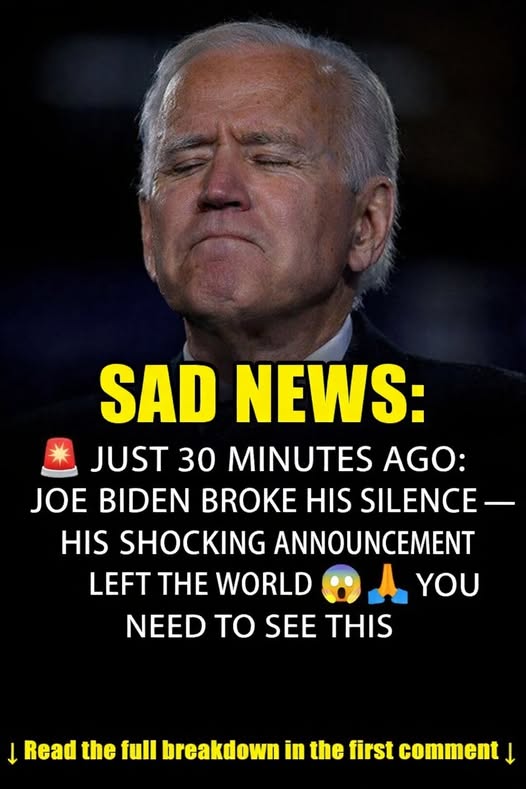
Our leaders rarely admit when the spotlight starts to feel heavier than the work itself. Yet that is exactly the tone that recently emerged from Joe Biden, who in a few measured, restrained remarks seemed to gesture toward a quieter phase of life and public engagement. It wasn’t framed as a dramatic exit or a sudden retreat. Instead, it felt more like a deliberate slowing of pace—an acknowledgment that the era of center-stage politics may be giving way to something less visible, but not necessarily less meaningful.
What stood out most was not any single declaration, but the mood underneath it: a sense of transition rather than termination. After decades spent moving through nearly every level of American political life—from Scranton’s working-class roots, to the long corridors of the Senate, through the vice presidency, and ultimately into the Oval Office—Biden’s reflections suggest an awareness that public influence does not simply disappear when campaigns end or titles fade. It changes form. It shifts location. It often moves away from podiums and headlines and into quieter, slower channels.
In that sense, the moment reads less like a curtain call and more like a recalibration. The idea being surfaced is that leadership is not confined to holding office, nor is relevance limited to election cycles. Influence, as his remarks imply, can persist through mentorship, through institutional guidance, through advocacy work, and through sustained engagement with civic life outside formal power. It can also live in the less visible but deeply consequential spaces where communities are organized, supported, and strengthened over time.
There is also a broader reflection embedded in this perspective—one that extends beyond any single political figure. It challenges the public to rethink what “service” actually means in modern society. Public life is often imagined as something performed by a small group of elected officials, but Biden’s framing pushes against that narrow definition. Teachers shaping young minds, neighbors organizing local initiatives, volunteers filling gaps in social support systems, caregivers holding families together, and local leaders solving immediate problems—all of these roles form the real infrastructure of civic life.
Seen through that lens, his personal journey becomes less about individual accomplishment and more about continuity. A life marked by personal loss, political endurance, and long-term participation in governance also becomes a case study in persistence rather than perfection. It invites a more grounded interpretation of legacy—not as something defined solely by legislation or high office, but as something measured in accumulated acts of attention, empathy, and responsibility.
Ultimately, the message being hinted at is not an ending, but a redistribution of presence. Stepping back from constant visibility does not necessarily mean stepping away from influence. In some cases, it may simply mean recognizing that impact does not always require a microphone or a stage. Sometimes it is carried forward in quieter forms—through guidance, through institutional memory, and through the continued effort to remain engaged with the fabric of public life, even when the spotlight has moved elsewhere.