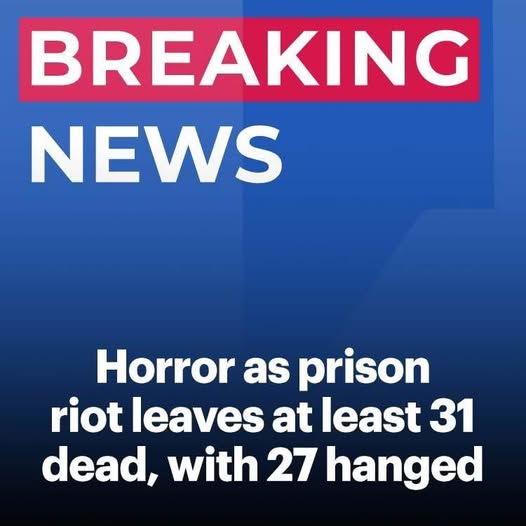
The screams began long before the first light of dawn could reach the prison walls.
In the darkness of Machala’s correctional facility, silence shattered into chaos—gunfire echoing through concrete corridors, explosions ripping through locked cells, and the distant sound of bodies collapsing where no one could reach them. For those inside, there was no distinction between night and nightmare. By the time the sun finally rose over Ecuador, the aftermath was already written in blood: more than 30 inmates dead, dozens more wounded, and an entire nation once again shaken by a familiar, sinking dread.
Officials moved quickly to issue statements, carefully chosen words attempting to frame the violence as yet another “riot.” Outside the prison gates, families gathered in growing numbers—parents, siblings, partners—clutching phones that refused to ring, scanning lists that seemed to change by the hour, and searching for answers no authority seemed ready to give. But behind those sealed gates and guarded walls, the truth felt far more complex—and far more disturbing.
What unfolded in Machala was not an isolated eruption of disorder. It was another violent chapter in a deeper, ongoing conflict that has steadily transformed Ecuador’s prison system into something resembling a battlefield—one where control is not held by the state, but contested and often dictated by organized criminal networks. Reports of asphyxiations and hangings pointed away from spontaneous chaos and toward something colder, more deliberate: executions carried out within a hierarchy where power is enforced through fear, and survival is negotiated cell by cell.
The immediate trigger may have been recent transfers to a newly designated maximum-security facility, a move intended to restore order. Instead, it appears to have ignited long-simmering tensions within an already fractured system. But beneath that spark lies a far more entrenched reality—years of institutional erosion, overcrowding, and the gradual surrender of authority to gangs that have evolved into disciplined, militarized structures operating with their own rules, intelligence, and command chains.
Outside the prison, grief hangs heavy in the humid air. Families remain pressed against barricades, holding onto fragments of information, waiting for confirmation that often arrives too late—or not at all. Inside government buildings, officials speak of reforms, investigations, and corrective measures, while struggling against an opponent that does not operate within the boundaries of policy or paperwork. Drug trafficking organizations have embedded themselves deep within the prison ecosystem, turning cellblocks into command centers, recruitment grounds, and execution sites.
And so the cycle continues—violence erupts, statements are issued, promises are made. Yet the structure that enables it remains largely intact.
Until that structure is dismantled, until control is truly reclaimed rather than merely declared, Machala will not stand as an exception. It will stand as a warning. And Ecuador will wake again, as it has before, to the sound of gunfire echoing from behind prison walls.