The words landed like a shockwave that reverberated far beyond Washington and the Vatican—sharp, sudden, and impossible to ignore.
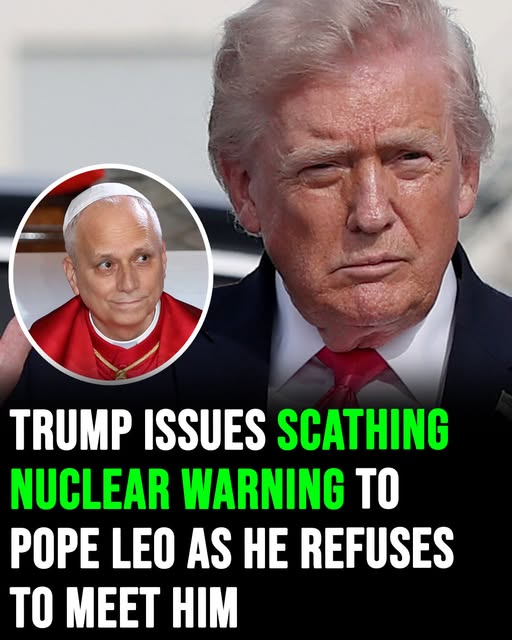
A sitting President of the United States publicly cautioned the Pope on the issue of nuclear weapons, escalating tensions to an almost unprecedented symbolic level, and then went a step further by declining any personal meeting with the pontiff. In response, bishops and senior clergy swiftly closed ranks around Pope Leo, signaling a unified defense of the Vatican’s moral authority. The exchange did not end there: Donald Trump intensified his position, accusing the Holy Father of effectively endorsing Iran’s pursuit of nuclear capability—an allegation that stands in direct contradiction to the Vatican’s documented statements and official record.
What emerged was not merely a diplomatic disagreement or a fleeting media controversy. It became something deeper and more consequential: a collision between two fundamentally different moral frameworks, each claiming a vision of truth, security, and peace.
On one side stood Pope Leo, speaking from a packed cathedral in Cameroon, delivering a forceful condemnation of global inequality and militarization. His message was stark and unflinching—he denounced “tyrants” who allocate vast national wealth to weapons and warfare while millions remain trapped in poverty, hunger, and neglect. His call echoed a long-standing Vatican tradition urging disarmament, dialogue, and the rejection of nuclear escalation.
On the other side, Donald Trump positioned himself as a defender of global stability, asserting that his policies were the final safeguard against the threat of nuclear-armed conflict with Iran. While insisting he was “not fighting with” the Pope, his statements simultaneously reframed and challenged the Pope’s position in a way that critics say distorted the Vatican’s actual stance.
The official record of the Holy See is clear and consistent. Pope Leo has repeatedly and unequivocally rejected the legitimacy of nuclear weapons, calling for global disarmament and warning of the catastrophic humanitarian consequences of nuclear escalation. The Vatican’s position has long emphasized diplomacy over deterrence and moral responsibility over military brinkmanship.
Yet the political narrative surrounding these statements quickly became contested terrain. Trump’s claim that the Pope would permit Iran to obtain nuclear weapons transformed a spiritual and ethical appeal into a politically charged accusation, placing the Vatican at the center of an international dispute it did not initiate.
Between these competing narratives lies a larger, unresolved question—one that extends beyond personalities and press statements. In a world where political power, existential fear, and religious authority intersect, who ultimately carries the voice of peace? And can that voice remain intact when interpreted through the competing filters of ideology, security, and global influence?