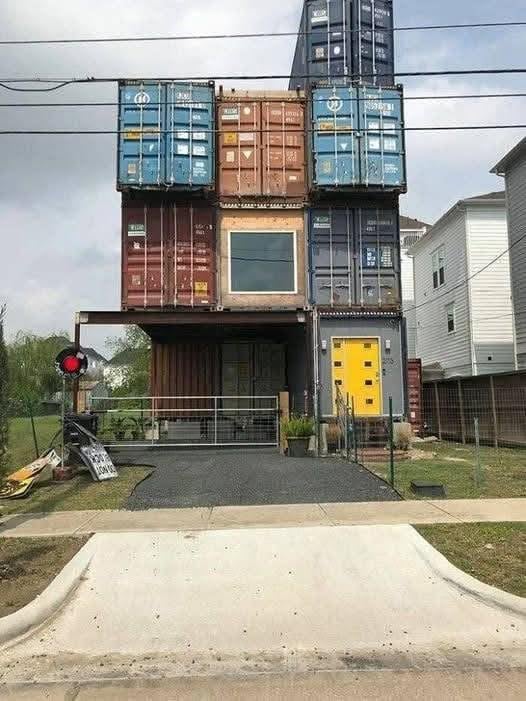
The first time the cranes appeared above the neighborhood skyline, no one quite believed what they were seeing. They assumed it was temporary—some construction detour, a miscalculation, a project that would quietly disappear before it ever truly began. But then came the shipping containers.
Rusted, weather-worn, and heavy with the marks of long-distance travel, they swung through the air one by one like enormous steel coffins being lowered into an unfamiliar grave. Each descent sent vibrations through the street, rattling windows and nerves alike. Conversations on porches stopped mid-sentence. Curtains shifted. Phones came out. And just like that, curiosity hardened into panic—and panic into outrage.
“Not here,” people said. “Not in our neighborhood.”
As more containers arrived, the confusion deepened. What looked like industrial waste from a forgotten port was suddenly being stacked with deliberate precision. Cranes rotated slowly, almost ceremonially, placing each massive block of steel into position. Welders moved across the structure like surgeons, sparks bursting into the air as seams were sealed and new edges were formed. What had begun as an odd intrusion was becoming something else entirely—something no one could yet name.
Whispers spread faster than the work itself. Some called it reckless. Others called it absurd. A few insisted it was dangerous, a structure destined to fail before it was even finished. And there were those who simply shook their heads in disbelief, convinced that whatever this was, it would become an embarrassment for the entire block.
Then came the transformation.
When the final container was secured and the last panel of glass slid into place, the site fell eerily quiet. The noise of construction faded, replaced by an uneasy stillness—as if the street itself was waiting for permission to judge what it had just witnessed.
Nightfall changed everything.
As darkness settled over the neighborhood, a soft glow began to emerge from within the structure. At first it was faint, barely noticeable—just a hint of warmth behind industrial steel. But within minutes, the entire building came alive. Light spilled through tall, carefully cut windows, washing across the raw metal exterior and softening its harsh edges. What had once looked like a pile of discarded cargo now stood illuminated like a modern sculpture—bold, deliberate, and strangely beautiful.
The same people who once called it an eyesore now found themselves slowing down as they passed. Some drove by twice. Others parked a little farther down the street just to get a better look.
Inside, the truth of it revealed itself even more dramatically.
Sunlight poured through expansive openings during the day, stretching across polished floors and clean architectural lines. The interiors felt unexpectedly calm—almost serene—contradicting everything the exterior suggested. The cold industrial shells of shipping containers had been reborn into warm, livable spaces where steel and glass worked together instead of against each other.
Each container told its own story. Once part of a global system of trade and exhaustion, they had been salvaged, reimagined, and reshaped into something intimate and enduring. Bolted together and carefully insulated, they formed a structure that was not just a home, but an argument made tangible: that beauty does not always come from starting fresh, and that waste can be rewritten into purpose.
Slowly, the neighborhood’s language began to change.
The jokes stopped first. Then the criticism softened. Eventually, even the harshest voices fell silent—not because they had been convinced, but because they no longer had the same certainty they once did.
Now, when people pass the house on McGowen Street, they don’t laugh or shake their heads. They slow down. They look. They hesitate just a moment longer than they mean to.
And somewhere beneath that hesitation is a quiet question growing stronger each day:
What if it was never ugly at all… but simply ahead of its time?