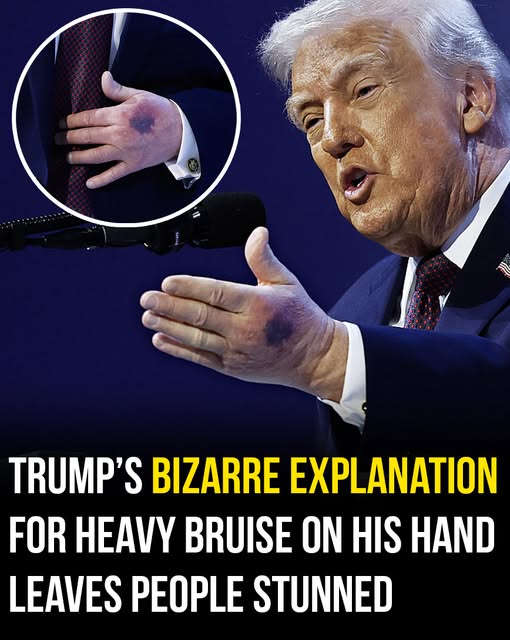
A single, small mark was all it took to ignite a political storm.
It began with what looked like an ordinary bruise on Donald Trump’s hand—an unremarkable discoloration that, under normal circumstances, would have gone unnoticed by most people. But in the hyper-scrutinized world of modern politics, where every photograph is dissected frame by frame and every detail becomes potential symbolism, that one image refused to stay small.
Within hours, it wasn’t just a bruise anymore. It was a headline. Then a theory. Then a debate that stretched far beyond health and into trust, transparency, and perception. At Davos, where global leaders were meant to be focused on economics, trade tensions, and geopolitical strategy, conversations were suddenly pulled sideways by a close-up photo circulating online. People zoomed in, slowed down footage, compared angles, and treated pixels like clues in a mystery.
The White House quickly moved to calm the speculation, offering a straightforward explanation: a minor bump—an everyday accident, made more noticeable due to routine use of blood-thinning medication and normal skin sensitivity that can come with age. Officials insisted there was nothing unusual behind it, nothing hidden, nothing alarming.
But in today’s environment, simple answers rarely end complicated conversations.
For many observers, the explanation only added fuel to the fire. Social media filled with competing interpretations: some saw a harmless explanation being twisted into conspiracy, while others saw yet another moment where official narratives felt too neat, too rehearsed, too convenient. The same image was now being interpreted in completely opposite ways depending on who was looking at it.
To critics, the bruise became a symbol—an invitation to question what else might be unspoken. To supporters, it became an example of how minor details are amplified into political ammunition. And for everyone in between, it was another reminder of how quickly modern information ecosystems can transform something small into something enormous.
The situation also highlighted a deeper reality: public figures now exist under constant visual surveillance, where even the most ordinary physical marks are treated as possible revelations. A faint discoloration becomes a talking point. A bandage becomes a storyline. A brief comment becomes a headline cycle.
In that sense, the bruise was never really about a bruise at all.
It became a mirror—reflecting a divided information landscape where trust is fragile, explanations are scrutinized, and certainty is rare. Even as the mark on his hand eventually faded, the conversation it sparked did not fade with it. It lingered, shifting from skin to perception, from health to politics, from fact to interpretation.
And long after the image disappeared from the front page, the questions it raised continued to circulate—unchanged, unresolved, and still searching for something solid to hold onto.