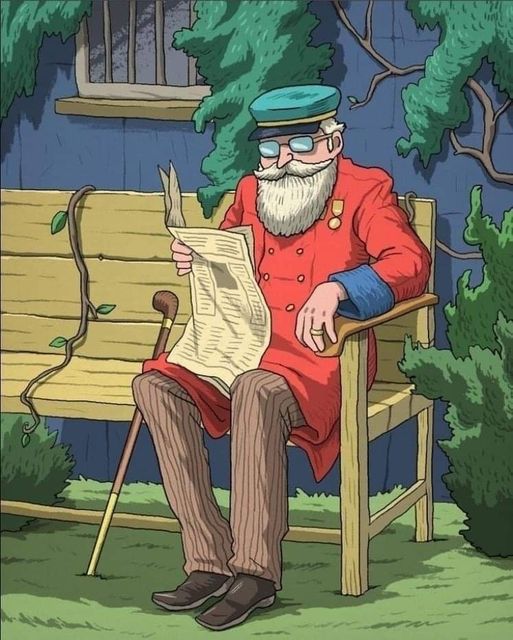
If you missed it, you’re not alone—most people do.
At first glance, it looks completely ordinary. A quiet, almost forgettable scene: an old man resting on a weathered wooden bench, surrounded by soft vines and fading light. His red jacket stands out just enough to catch your attention, but nothing about the image suggests a puzzle. And yet, hidden inside this simplicity is something that repeatedly breaks people’s perception—a tiny pipe, so cleverly disguised that thousands of viewers swear it isn’t there at all.
People lean closer. They squint. They scan every detail like detectives under pressure. The tangled vines? Nothing. The shadowed folds of the bench? Empty. The man’s jacket, his posture, the surrounding stillness—none of it seems to give anything away. And still, the answer remains right in front of them, almost mocking how easily it escapes notice.
Then, after frustration builds, someone finally sees it—and the realization arrives like a quiet shock.
“Look at the cane…”
And suddenly, everything changes.
Because the pipe was never hidden in the background or cleverly tucked behind an object. It was right there in plain sight, fused seamlessly into the man’s walking cane. The bowl, the stem, the curve—every part of it designed to mimic the natural shape of support and balance. Your brain, trying to be efficient, had already labeled it: just a cane. Once that label is applied, the mind stops questioning. It simplifies, it accepts, it moves on.
That’s what makes this illusion so powerful. It doesn’t rely on complexity—it relies on your certainty.
We trust our eyes more than anything else, believing that seeing is the same as understanding. But this small scene quietly exposes a different truth: perception is not passive. It is edited in real time by expectation, memory, and habit. What you assume to be true often arrives before what you actually observe.
And then comes the moment of recognition.
When you finally see the pipe, it doesn’t feel like discovery alone—it feels like a reset. A brief jolt, followed by a strange relief, even a spark of pride. You wonder how you missed something so obvious, and yet that confusion is exactly the point. The puzzle was never about intelligence—it was about attention.
That “aha” moment lingers longer than expected. It becomes more than solving a visual trick; it becomes a reminder that perception can be rewritten with patience. What you overlook in a second glance might hold an entirely different story when you slow down enough to question it.
And as the image fades from your mind, one question quietly remains:
If something this obvious can hide in plain sight… what else in your world are you not really seeing?