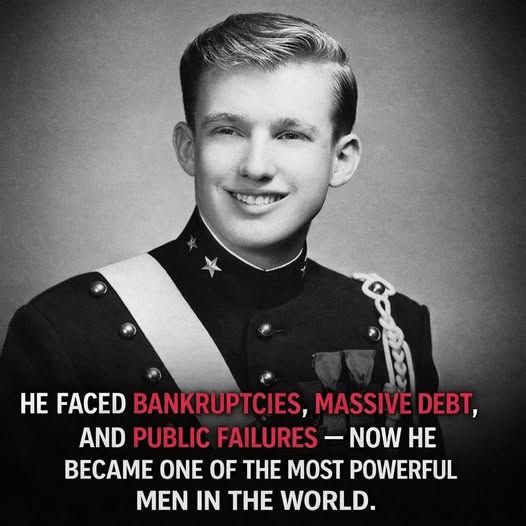
He was never supposed to make it this far.
From the beginning, the story had all the markings of an ending that should have come early. A businessman drowning in debt, a public figure turned punchline, a name repeated more with ridicule than respect. Each new setback felt like the final chapter. Each collapse looked irreversible. And yet, time after time, when the narrative seemed ready to close, Donald Trump somehow forced it open again.
His life moves like a series of cliffhangers stitched together into something strangely unbreakable. A defiant teenager sent to military school. A young heir stepping out from the shadow of a powerful father who believed business was a battlefield and mercy a weakness. In that world, winning wasn’t encouraged—it was demanded. Losing wasn’t a lesson—it was a threat. And spectacle, even then, was already part of the strategy.
New York City became his proving ground. Manhattan wasn’t just a place; it was a stage where ambition had to be loud to survive. Glass towers, golden lettering, high-profile deals—each one less about real estate and more about identity. He didn’t just build buildings; he built a persona large enough to be seen from across the skyline. When the deals worked, they reinforced the myth. When they failed, they became part of the drama.
And there were failures—enormous ones. Casino collapses, mounting debt, financial institutions circling like predators waiting for the final fall. At that point, most careers don’t recover. Most names quietly fade into cautionary tales. But instead of disappearing, he reframed the story. He didn’t just negotiate with creditors; he negotiated with perception itself. The value wasn’t only in assets anymore—it was in the brand, in the spectacle, in the sheer recognition of the name printed on the door.
Then came television, and with it, a reinvention few could have predicted. The businessman became a prime-time authority figure, an emblem of decisive power packaged for entertainment. In living rooms across the country, the narrative of failure was slowly overwritten by a new image: confident, unshaken, always in control. The past didn’t vanish, but it was drowned out by the performance of success.
Politics was the final turn in a story already full of unexpected chapters. What began as a long-shot campaign became a seismic disruption. He didn’t just enter the political arena—he unsettled it, bent it, and forced it to respond. Alliances shifted. Norms were tested. Conversations changed. And suddenly, the debate was no longer only about one man’s policies, but about the identity and direction of an entire nation.
Whether viewed with admiration or criticism, his trajectory carries a consistent thread: refusal to exit the stage. Every time the spotlight dimmed, he stepped back into it. Every time the credits seemed ready to roll, he demanded another scene.