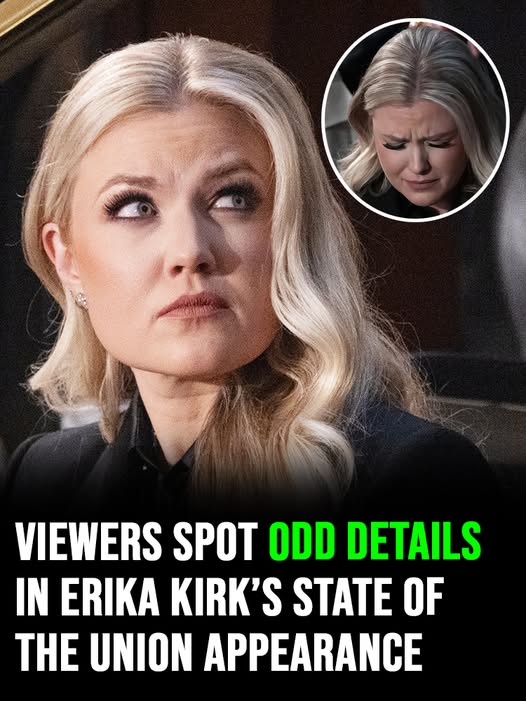
Erika Kirk’s face trembled under the unforgiving glare of live television lights. For a few fragile seconds, the nation watched a widow trying to steady her breathing, her composure, and her breaking heart. But in the age of instant judgment, those seconds were more than a moment of grief — they became a spectacle. Within minutes, social media transformed her expression into a courtroom, and millions appointed themselves judge and jury. Was she mourning… or performing?
The question spread faster than the clip itself.
As President Donald Trump praised her slain husband, Charlie Kirk, calling him a “martyr” who reignited faith and conviction among young Americans, cameras cut to Erika in the balcony. She stood there in silence, her hands clasped tightly, her eyes glistening as tears threatened to fall. The applause below her roared like a tidal wave, yet she seemed suspended in a different world — one defined not by politics, but by absence.
For a fleeting moment, her grief was unfiltered. Raw. Human.
And then the internet slowed it down.
Viewers replayed the footage frame by frame, analyzing the tilt of her chin, the timing of her tears, the tremble of her lips. Comment sections filled with accusations. Some claimed her sorrow looked rehearsed. Others argued her reaction seemed delayed, too composed, too aware of the cameras. In a matter of hours, her most vulnerable public moment was dissected like evidence in a trial.
But just as swiftly, another chorus rose to defend her.
Supporters reminded critics that grief has no script. It does not follow stage directions. It can look stoic one second and overwhelming the next. Some people collapse. Others freeze. Many hold themselves together until the world stops watching. The expectation that sorrow must appear a certain way — neat, cinematic, undeniably “authentic” — says more about the audience than the mourner.
What unfolded that night was supposed to be a tribute. Instead, it became a mirror reflecting a fractured nation.
The State of the Union address has long been a stage for unity, symbolism, and carefully crafted messages. Yet Erika Kirk’s brief appearance revealed something deeper and more unsettling: how quickly empathy can be replaced with suspicion. In today’s hyper-polarized climate, even tears are interpreted through ideology. A widow’s pain becomes political currency. A trembling face becomes content.
The debate was never truly about whether her tears were real.
It was about trust. About how conditioned we’ve become to doubt sincerity, especially when it intersects with power and politics. It was about how grief — once considered sacred and private — now unfolds under the relentless scrutiny of millions armed with pause buttons and opinions.
Erika Kirk did not step onto that balcony as an actress. She stood there as a woman who lost her husband. Yet in a country divided by narratives, her humanity was almost instantly overshadowed by argument. The applause faded. The speech moved on. But the clip continued circulating, feeding a digital culture that rarely allows space for complexity.
In the end, her trembling face told a story far larger than one family’s tragedy. It revealed how deeply suspicion runs, how quickly we weaponize emotion, and how fragile compassion can feel in the noise of a culture war.
Because sometimes, what we’re really watching isn’t just a person grieving.
It’s ourselves — and what we’ve become.