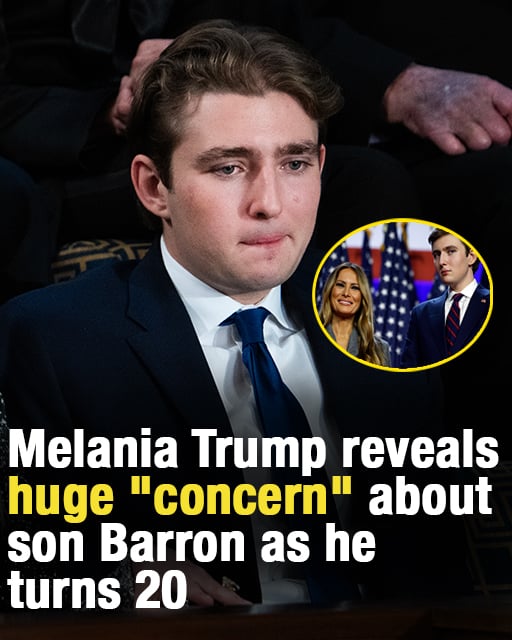
Barron Trump has quietly stepped into a moment his mother has spent years hoping would never truly arrive—the age when distant conflicts stop feeling abstract and begin to feel personal. For most of his life, war was something discussed in briefings, debated on television, or framed in headlines that came and went. But now, with global tensions rising and talk of military escalation resurfacing in public discourse, that distance is shrinking. What once felt far away is inching closer, pressing against the edges of home and family.
As conversations grow louder about keeping “all options on the table” in the face of mounting strain with Iran, a word many Americans haven’t seriously grappled with in decades is finding its way back into everyday conversation: the draft. It carries a weight that transcends politics—a quiet, creeping anxiety that reaches into living rooms, dinner tables, and the private thoughts of parents who once believed such fears belonged to another era. For Melania, that fear is no longer theoretical. It has a name, a face, and a birthday that has now placed her son within the realm of possibility.
Barron’s 20th birthday isn’t just a celebration of adulthood—it feels like a turning point, where the protections of youth give way to the responsibilities and risks of being a citizen in uncertain times. For years, Melania worked with careful precision to give her son something rare in a political dynasty: distance. Distance from the noise, from the scrutiny, from the relentless churn of public life. She built a quiet space around him, as much as one can when the world is always watching. But time has a way of dissolving even the strongest barriers.
Now, the stakes are no longer about headlines or public perception. They are about something far more visceral—the safety of a child she raised largely out of view, now standing at an age where the machinery of the state could, in theory, reach him. Across the country, families are beginning to feel that same unease. The hypothetical is becoming imaginable again. The “what if” is no longer distant.
There’s an irony woven into this moment that is difficult to ignore. A father who once navigated his own path around military service during Vietnam could now find himself confronting a reality where his youngest son stands directly within the age bracket historically associated with conscription. It’s a stark reminder that power, influence, and wealth—while formidable—do not fully insulate anyone from the broader systems that govern a nation.
For Barron, who has lived much of his life on the periphery of public spectacle, this moment marks an unexpected shift. He is no longer just the quiet figure in the background of historic photographs. He is a young man at the intersection of family legacy and national uncertainty. And for Melania, the concern is stripped of all political framing. It is not about policy or debate. It is about something simpler, deeper, and more universal: a mother confronting the possibility that the world she tried to hold at bay for her son may now be impossible to keep outside the door.