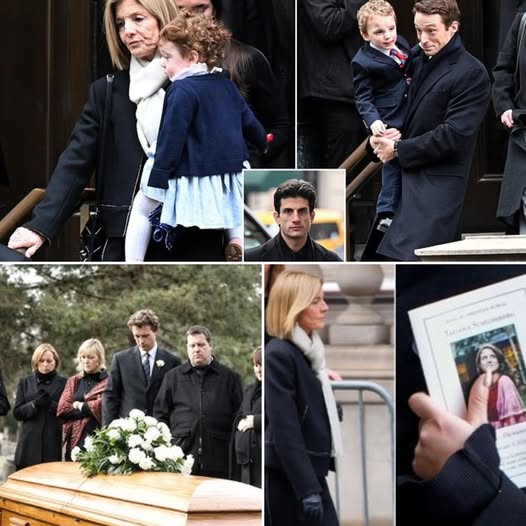
Caroline Kennedy held her granddaughter close, her arms wrapped protectively around the small, warm weight of a life just beginning, as the church fell into a reverent hush. Grief settled heavily over the pews—thick, wordless, unanswerable. A young mother was gone. Another branch of a historic family had been broken. In the stillness of a Manhattan church long entwined with Kennedy sorrow, a question moved quietly from heart to heart: how do you explain a loss this vast to children barely old enough to form memories? How do you teach them the shape of someone they will grow up missing?
On a bitter January morning in New York City, three generations of Kennedys walked through the doors of St. Ignatius of Loyola knowing that life, from this moment on, would be divided into before and after. Caroline Kennedy entered carrying baby Josephine, her face composed but etched with the kind of pain that never fully fades. Beside her walked her son Jack, and her son-in-law, Dr. George Moran, who bent gently toward little Edwin, guiding him down the aisle with a steadying hand. The church—once the setting for Jacqueline Kennedy’s memorial—absorbed yet another chapter of profound family loss, as relatives, close friends, and President Joe Biden gathered not to speak, but simply to bear witness.
The echoes of history were impossible to ignore. This was a place that remembered grief, that seemed to hold it in its walls. Yet amid the crushing sorrow, there was a quiet, defiant resolve: Tatiana Schlossberg would not be remembered solely through the lens of tragedy. She was more than the ending of her story.
Family members spoke of her as she lived—brilliant, driven, fiercely thoughtful. An environmental journalist with a clear and urgent voice, Tatiana wrote not for abstraction but for the future she believed in, for the planet her children would one day inherit. Even as her own time narrowed, her focus widened outward. In her final months, she devoted herself to what mattered most: writing letters meant to last, preserving memories, and finding meaning in the smallest rituals of daily love. Each act was a way of staying present, of leaving behind something solid and sustaining.
When the service ended and the doors of the church opened once more to the cold New York air, those closest to her carried more than grief with them. They carried a promise. A shared determination that her children would grow up knowing not only what their mother endured, but who she was—her curiosity, her stubborn hope, her joy. That her life, though heartbreakingly brief, was full, purposeful, and deeply loved.