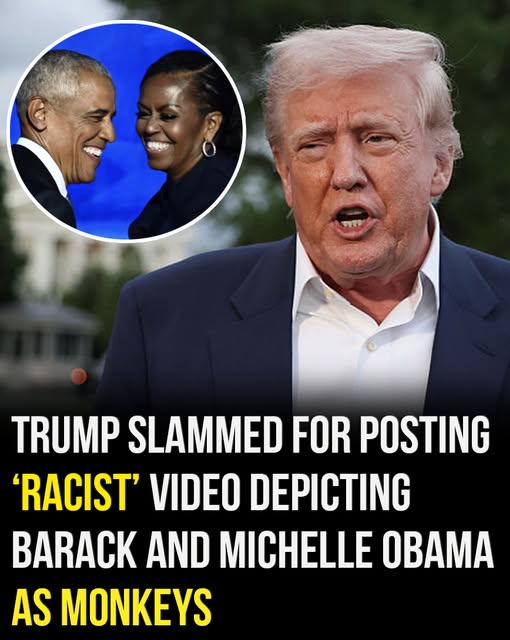
Donald Trump didn’t merely “post a meme.” He struck a match and tossed it straight into the dry brush of America’s most volatile political and racial divides.
In a single Truth Social video—one of more than 60 posts unleashed in rapid succession—the former president is accused of crossing a line many believed should never be touched so casually. The video, critics say, portrays Barack and Michelle Obama as monkeys, a depiction that instantly ignited outrage across the political spectrum. Within minutes, social media erupted, civil rights advocates sounded alarms, and Republicans found themselves once again cornered by a familiar question: defend Trump, or finally draw a line.
This wasn’t just another recycled election grievance or late-night internet provocation. For millions of Americans, the imagery carried a chilling historical weight. Comparing Black people to monkeys is not a throwaway insult—it is one of the oldest and most dehumanizing racist tropes in U.S. history, rooted in slavery, segregation, and centuries of violence. To those critics, the video felt deliberate, not accidental. Not edgy humor, but a calculated nod to something ugly and unmistakable.
Reaction was swift and blistering. Trump’s detractors labeled the post “vile,” “openly racist,” and evidence of a moral collapse from a man still seeking the highest office in the land. For them, it confirmed long-standing warnings about Trump’s willingness to inflame hatred for attention and power. Some former allies, visibly shaken, publicly distanced themselves, saying this moment went further than anything before.
Yet the backlash also exposed how deeply fractured the country remains. Loyal supporters rushed to Trump’s defense, brushing off the criticism as “manufactured outrage” and arguing that liberals were once again reading malicious intent into internet culture. Some insisted it was merely political theater—crude, yes, but no different from the online chaos that now defines modern discourse. The White House echoed that minimization, framing the uproar as overblown and unserious.
But for many Americans, this was neither harmless nor abstract. It felt personal. It felt familiar. And it felt dangerous.
Amid the noise, one absence has grown impossible to ignore: the silence of Barack and Michelle Obama. No statements. No counterpunch. No acknowledgment at all. That quiet has only amplified the moment’s gravity, allowing the controversy to speak for itself. In a political climate addicted to instant reaction, their restraint now resonates more powerfully than any rebuttal—leaving the nation to wrestle with what was shown, what was meant, and what it says about where American politics may be headed next.