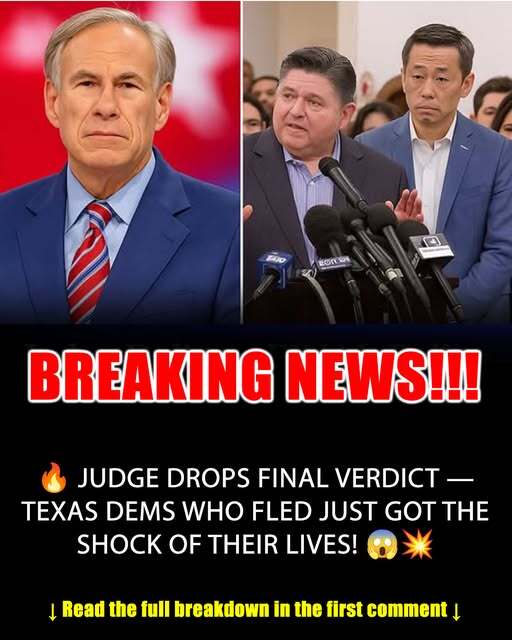
A procedural showdown unfolding in Austin has escalated into a high-stakes confrontation after leaders of the Texas House of Representatives moved to penalize Democratic lawmakers who left the state in an effort to block legislative action. What began as a tactical walkout has now evolved into a broader struggle over authority, accountability, and the boundaries of political protest.
Under the newly proposed measures, House members who remain absent risk losing access to their salaries and could face accumulating daily fines. Republican leadership has characterized the move as a necessary enforcement of attendance rules, emphasizing that lawmakers are elected to be physically present and engaged in official proceedings. From this standpoint, extended walkouts are portrayed not as principled resistance, but as a disruption that paralyzes the institution and prevents the legislature from carrying out its constitutional duties.
Supporters of the policy frame it as a matter of basic accountability. They argue that public officials should not continue to receive taxpayer-funded compensation while actively avoiding participation in the legislative process. In their view, financial consequences are not punitive but corrective—a mechanism to restore order, ensure quorum, and protect the functional integrity of the House.
Opponents, however, see a far more troubling picture. Critics contend that withholding pay and imposing fines weaponizes economic pressure, turning a political disagreement into a form of coercion. They warn that such measures could chill legitimate protest, particularly for minority parties that have historically relied on walkouts as one of the few tools available to resist legislation they see as harmful. From this perspective, the policy risks establishing a precedent in which financial leverage replaces dialogue and negotiation as the primary means of resolving political standoffs.
As the impasse drags on, pressure continues to mount on all sides. Lawmakers involved in the walkout face intense scrutiny from constituents, party leadership, and the media, while House leadership confronts growing questions about the limits of its disciplinary authority. The dispute is no longer confined to procedural rules; it has become a test of political will, institutional norms, and public trust.
Viewed more broadly, the conflict underscores a recurring tension within democratic systems: how to reconcile the obligation to maintain procedural order with the right of minority factions to resist and protest. Walkouts have long been embedded in legislative history as a form of dissent, yet enforcement mechanisms exist to keep governing bodies operational. When those forces collide, the resulting friction often exposes deeper fractures within the political system.
Whether this standoff ultimately ends through compromise, judicial intervention, or simple political exhaustion, its consequences are unlikely to fade quickly. When lawmakers eventually return to the chamber, the challenge will extend beyond resuming votes. Rebuilding working relationships—strained by mistrust, hardened rhetoric, and escalating tactics—may prove far more difficult.
In moments like this, the central question is not merely who wins or loses the immediate battle, but how democratic institutions preserve both order and legitimacy in an era marked by deep division and diminishing consensus.