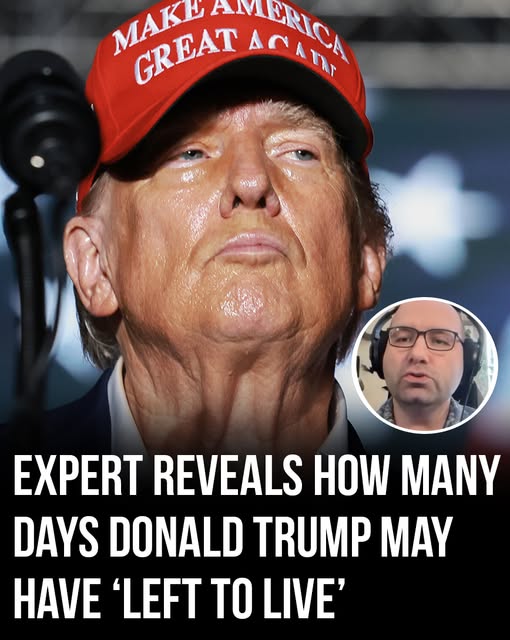
He insists he has never been stronger—physically, mentally, or politically. Yet a veteran physical therapist is now sounding an unsettling alarm, suggesting that Donald Trump may be running against an invisible clock. In a detailed and provocative analysis, the therapist points to a series of moments captured on camera: speech that appears slurred or meandering, an unusual and sometimes unsteady gait, and lapses in recall that seem to go beyond ordinary slip-ups. Taken together, he argues, these signals hint at something far more serious than simple fatigue or age.
The analysis comes from Adam James, a physical therapist with 14 years of clinical experience. James is careful to draw a clear line—he has never examined or treated Trump, and his observations are based solely on publicly available footage, speeches, and reported behavior. Still, he maintains that long experience trains the eye to notice patterns others might overlook. What he sees, he says, is not a single odd moment, but a recurring constellation of neurological red flags.
James describes episodes of uneven or guarded walking that could suggest balance issues, subtle signs of possible one-sided weakness, and repeated struggles with basic facts that once came easily. He also highlights Trump’s speech patterns, noting a tendency to circle back to the same narrow set of words and phrases, as if broader language access were becoming harder to reach. In isolation, any one of these signs might be dismissed. Together, James argues, they form a pattern that is difficult to ignore.
Based on that pattern, he raises the possibility—while stressing it is not a diagnosis—of Frontotemporal dementia, a condition known for quietly undermining judgment, impulse control, emotional regulation, and personality long before it becomes obvious to the public. Unlike more widely recognized forms of dementia, it can progress in ways that are subtle at first, revealing itself through behavior changes rather than dramatic memory loss.
What gives this warning its emotional and political weight is not merely the speculative condition itself, but the context surrounding it. Trump is approaching 80, shows visible signs of strain, and seeks—or holds—one of the most demanding and high-stakes positions on the planet. Even without confirmation of any illness, the suggestion of potential cognitive decline raises an uncomfortable but unavoidable question: what happens when immense power rests in hands that may not remain as steady as they once were?
At its core, the therapist’s message is not a verdict, but a caution. Human biology, he reminds viewers, does not bend to ambition or bravado. And when the pressures of the presidency collide with the vulnerabilities of the aging brain, the consequences—whatever their cause—could extend far beyond a single individual.