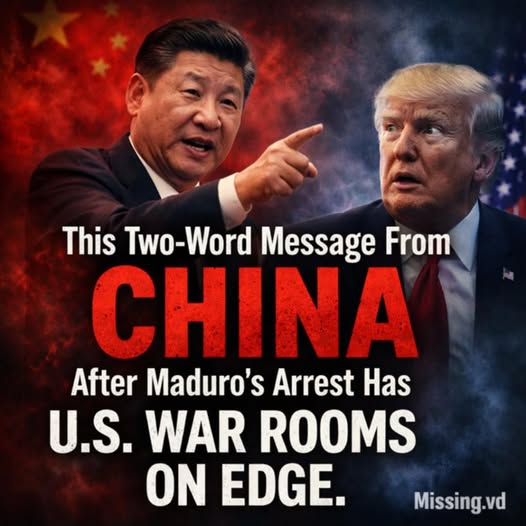
For hours, Washington went still. The hum of constant communication — the chatter of aides, the rhythmic buzz of secure lines, the shuffling of classified folders — all seemed to stop at once. Briefings were abruptly canceled. Phones that usually rang nonstop fell silent. Behind heavy doors, a handful of the most senior officials in the United States government gathered in rooms where clocks seemed to tick louder than voices. The confidence that had defined their tone only hours earlier — the kind that comes from believing you control the board — had turned cold.
The reason for the sudden shift came down to two words. Just two.
No podium, no press release, no photo op — just a private message from Beijing, sent quietly through trusted backchannels, and immediately recognized by those who received it as something far more consequential than routine diplomatic caution. The phrasing was spare, almost understated, yet unmistakable. To those trained in the language of power, it was the kind of warning that doesn’t need to be shouted to be heard around the world.
Those two words carried the weight of years of investment, strategy, and quiet maneuvering. They were not about Venezuela alone. They were about leverage — the kind China had been carefully cultivating across the developing world, and particularly in Latin America. For Beijing, Venezuela is more than a distant partner; it’s an economic lifeline and a geopolitical foothold on the edge of America’s own sphere of influence. Billions in loans and oil-backed deals have tied the two nations together, giving China both access to energy and influence in a region once considered untouchable by rival powers.
So when intelligence suggested that Washington might move to unseat Nicolás Maduro — whether through covert support or direct intervention — Beijing did not issue a statement. It drew a line. A quiet one. A deliberate one. And it did so in the language of restraint that carries the menace of consequences left unsaid.
Inside the Pentagon, the atmosphere changed instantly. Analysts who had spent weeks modeling the political collapse of Caracas suddenly began tracing risk scenarios that reached far beyond South America. Commanders who had been focused on humanitarian corridors now spoke in low tones about naval routes and cyber threats. The message, once decoded, left no room for misinterpretation: if the U.S. forced Maduro from power, China would not answer in Venezuela — it would answer somewhere else.
No one in Washington truly believes Chinese troops will appear in the Caribbean. But no one doubts Beijing’s reach, either. A move in the Pacific. A provocation in the Taiwan Strait. A sudden financial squeeze in an already fragile market. There are countless ways to respond — and each of them would demand an American answer.
In geopolitics, the most powerful messages are often the shortest ones. They arrive without headlines, travel through unmarked channels, and leave behind rooms full of people staring at the same two words — knowing they’ve just been told where the edge truly lies.