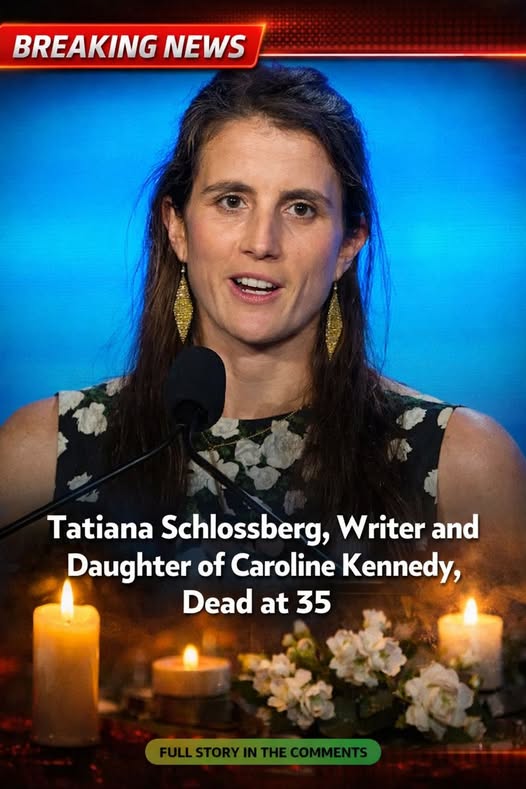
A young mother. A dying daughter. A family already splintered by a distinctly American tragedy.
Tatiana Schlossberg’s final year was not measured in months or milestones but in the slow, relentless rhythm of borrowed time. The granddaughter of President John F. Kennedy, she had grown up in the long shadow of myth and mourning. But her final story was not about Camelot’s ghosts — it was about the fierce, quiet love of a mother who knew she would not see her children grow up.
Between chemo drips and bedtime stories, she lived in two worlds at once — one sterile and white-lit, filled with the hum of machines; the other soft and fleeting, filled with the laughter of her little boy and the gurgles of her baby girl. She tried to memorize everything — the shape of their hands, the sound of their breathing, the scent of their hair when they fell asleep against her chest.
Friends said she wrote late at night when the pain allowed, her laptop glowing beside the hospital bed. In essays that read like letters from the edge, Tatiana confessed her greatest fear was not death itself, but disappearance — the quiet erasure that comes when the people you love most begin to live beyond your memory. “I don’t want to fade,” she wrote. “I want to leave a trace — in their laughter, in their habits, in the way they care for the world.”
That world, for Tatiana, was both intimate and immense. As an environmental journalist, she had dedicated her life to exposing the consequences of human neglect — the rising seas, the silent forests, the forgotten species. Yet, in her final months, she faced a bitter irony: watching members of her own extended family publicly challenge the very science she relied on to survive. Her cousin’s crusade against vaccines and climate policy became a cruel backdrop to her own fragile fight to stay alive.
The Kennedy legacy, so often defined by hope and heartbreak, grew heavier still. Her mother, Caroline Kennedy — a woman who had already endured the losses of her father, her uncle, and her brother — now found herself standing at the unbearable threshold of outliving her child. The tragedy was Shakespearean in scope, yet deeply human in its ache.
Still, Tatiana refused to be remembered only as another Kennedy gone too soon. She insisted on being more — a writer, a witness, a mother who turned even her dying into an act of fierce remembrance. Her words were not elegies but instructions: love without hesitation, grieve without shame, and never stop trying to protect what is worth saving.
In the end, her life became a paradox of fragility and endurance. She could not stop the cancer from taking her body, but she left behind something far stronger than she feared losing — a memory radiant enough to outlast her absence, echoing through the very people she was so afraid to leave.
Tatiana Schlossberg did not survive her final year.
But she did not vanish either.
She became what she always hoped her children would remember — a voice that still matters, a love that refuses to fade.