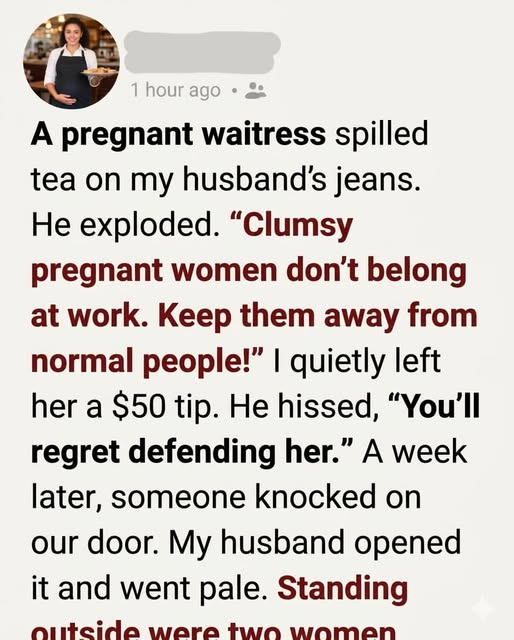
It all began with something so small that, under ordinary circumstances, it would have been forgotten within minutes—a single spilled cup of tea. Yet that brief moment would unravel emotions, expose hidden truths, and leave behind a lesson none of us would ever forget.
The restaurant had been warm and lively that evening, filled with the soft clatter of dishes, quiet conversations, and the comforting aroma of freshly prepared food. My husband, George, and I had gone there for what was supposed to be a peaceful dinner after a long week. Everything seemed perfectly normal until one sudden accident changed the entire atmosphere.
As the young waitress approached our table carrying a tray of drinks, her movements seemed careful but tired, as though exhaustion weighed heavily on her shoulders. In one unfortunate second, her hand slipped. A cup of hot tea tipped over and spilled across the table, splashing directly onto George’s expensive designer jeans.
The room froze.
The waitress immediately stepped back in horror, her face draining of color. “I’m so sorry… I’m so, so sorry,” she repeated, her voice trembling uncontrollably. Her hands shook as she tried to clean the mess, and I noticed one of them instinctively resting on her pregnant belly, as if protecting the life she carried while trying not to break down herself. She looked overwhelmed, exhausted, and frightened—as though this accident was only one burden in a much heavier life.
But George didn’t see any of that.
Instead, his frustration exploded instantly. His voice rose sharply across the restaurant as he angrily criticized her for being careless. What should have been a simple mistake became a painful scene of public humiliation. Conversations stopped. Forks paused midair. Every nearby table turned to watch.
The young woman stood there silently, absorbing every harsh word while trying desperately not to cry.
I felt my stomach tighten with discomfort.
“George,” I said gently, trying to calm him, “it was an accident. She didn’t mean to do it.”
But he brushed my words aside, too angry to listen.
Within moments, the restaurant manager hurried over, apologizing repeatedly and offering to pay for the cleaning of his clothes. The staff worked quickly to ease the tension, but the emotional damage had already been done. The waitress—whose name tag read Evelyn—stood quietly beside the table, embarrassed beyond words.
Then George stormed off toward the restroom, still muttering angrily under his breath.
The moment he disappeared, the atmosphere softened slightly.
I turned to Evelyn and spoke quietly. “Please don’t blame yourself,” I told her kindly. “Mistakes happen to everyone.”
For the first time, her eyes lifted to meet mine. They were filled not only with embarrassment, but exhaustion and sadness too. I could tell life had not been easy for her lately.
“You’re doing your best,” I continued softly. “Don’t let one moment make you feel small.”
Her expression shifted ever so slightly, as though those few words gave her permission to breathe again. Sometimes, compassion during someone’s worst moment can mean more than grand gestures ever could.
I thought that would be the end of it.
But about a week later, the incident returned to our lives in a way neither George nor I could have expected.
That evening, there was a knock at our front door.
When I opened it, I was stunned.
Standing there was Evelyn.
Beside her stood a sharply dressed woman I recognized immediately from photographs I had seen before—George’s senior manager from work.
For a brief second, nobody spoke.
Then the realization slowly spread across George’s face as they stepped inside. The same waitress he had publicly humiliated now stood connected to someone whose opinion carried enormous weight in his professional life.
The atmosphere in the room changed instantly.
Evelyn appeared nervous but composed this time, while the manager remained calm and professional. There was no anger in her voice when she began to speak—only disappointment.
She explained that Evelyn was a close relative of hers and had recently taken extra shifts while preparing for motherhood. She then spoke directly to George, not as an employee, but as a person who needed to hear an important truth.
She spoke about patience.
About kindness.
About how someone’s position, uniform, or job title should never determine the amount of respect they deserve.
“Character,” she said calmly, “is revealed most clearly in moments of inconvenience.”
The room fell silent after that.
George, usually confident and outspoken, had nothing to say.
For the first time since the incident, I saw genuine reflection in his eyes.
After Evelyn and the manager left, the silence in our home felt heavy—but meaningful. It wasn’t simply about spilled tea anymore. It was about dignity, empathy, and the way we choose to treat people when we believe their role in our lives is insignificant.
That night left behind a truth far greater than embarrassment or consequences:
Respect is not something reserved for important people. It is something we choose to give to every human being, in every interaction, no matter how small the moment may seem.