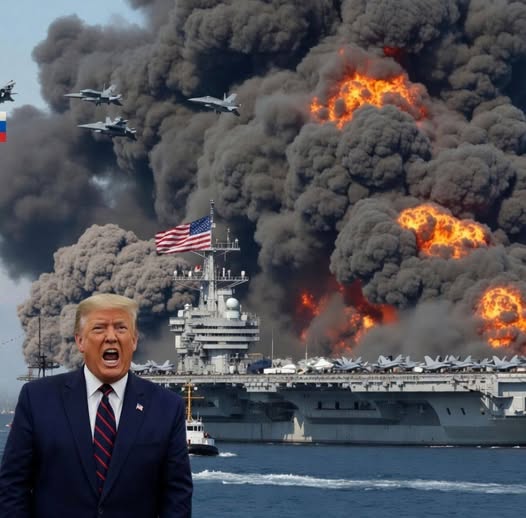
Early, unconfirmed reports are emerging of what appears to be a sudden and highly coordinated strike on a heavily protected maritime vessel, an incident that—if verified—would represent one of the most alarming security breaches in recent memory. Initial accounts suggest the attack unfolded with unexpected speed and precision, reportedly leaving defensive systems with little to no time to fully activate or respond in an effective manner.
According to sources familiar with the developing situation, the impact of the strike may have been severe, resulting in extensive structural damage and potentially catastrophic losses. While details remain fragmented and inconsistent across early reports, the scale of destruction being described has already raised serious concern among defense communities and international monitoring organizations.
Even more troubling are the immediate questions now being asked: How could a target believed to be so heavily fortified and continuously monitored be successfully engaged in such a manner? What vulnerabilities were exploited, and were they previously known or entirely unforeseen? These uncertainties are fueling urgent analysis among military experts, who are now closely examining possible scenarios ranging from advanced tactical innovation to intelligence failures or systemic gaps in defensive coverage.
At this stage, no official confirmation has been issued by relevant authorities, and the situation remains fluid. Nevertheless, the story has already begun circulating rapidly across global media outlets and social platforms, where speculation is intensifying alongside genuine concern. The absence of verified facts has not slowed public attention—instead, it has amplified debate, with analysts, commentators, and observers attempting to piece together fragmented information in real time.
If these reports are ultimately confirmed, the implications could be far-reaching. Such an event may signal a significant escalation in modern conflict dynamics, potentially reshaping long-standing assumptions about naval security, deterrence, and the resilience of even the most advanced military assets. It could also trigger a reassessment of strategic doctrines, particularly regarding how high-value targets are protected in increasingly complex and contested environments.
However, military officials and geopolitical experts are strongly urging restraint in interpretation. They emphasize the importance of distinguishing verified intelligence from early-stage speculation, especially in moments of heightened tension. History has shown that misinformation can spread rapidly during unfolding crises, often distorting public perception before facts are fully established. In this case, the uncertainty itself is becoming part of the global response.
Despite the lack of clarity, the alleged incident has already captured the attention of governments, defense analysts, and international policy institutions. Emergency discussions are reportedly underway in multiple strategic circles, with particular focus on assessing potential causes, identifying responsible actors if any, and evaluating broader security implications.
Some analysts are beginning to explore deeper strategic questions. Could this, if confirmed, represent the emergence of a new era in warfare defined by rapid, high-impact, precision strikes against traditionally secure assets? Or might it instead be an isolated and highly unusual occurrence, unlikely to redefine existing military paradigms? At present, such questions remain open-ended, with no definitive evidence to support any single interpretation.
As investigative efforts continue and authorities work to verify the authenticity of early reports, global attention remains fixed on each new development. Every emerging detail—no matter how small—has the potential to reshape understanding of the situation and clarify what may ultimately be regarded as a pivotal moment in contemporary security history.
For now, the narrative remains incomplete. The world waits for confirmation, clarity, and context. And until those arrive, one central question continues to dominate discussions across diplomatic, military, and public spheres: what truly happened—and what consequences may follow next?