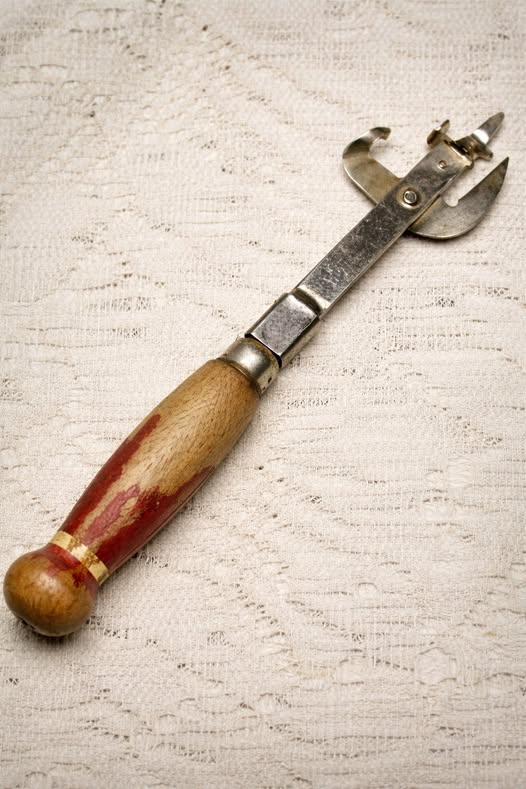
It started, as these things so often do online, with something almost absurdly small—an image. A single photograph of a rusted, jagged piece of metal pulled from what was described as a grandmother’s kitchen drawer. Nothing dramatic at first glance, just an old tool sitting against worn wood. But the moment it appeared on the internet, it didn’t stay small for long.
The reaction was immediate, almost visceral.
People zoomed in. People recoiled. People argued.
Because the object didn’t look like something meant for food or comfort or home at all. It looked industrial, aggressive—like it belonged in a workshop, or worse, somewhere far from kitchens and warmth. One comment called it a “trench tool,” another swore it looked like a “medieval punishment device.” And from there, the internet did what it always does best: it spiraled.
Stories began pouring in. Half-remembered childhood injuries. Fingertips nicked open in the middle of rushed dinners. Tin cans that fought back harder than expected. Kitchens that felt less like places of nourishment and more like arenas of improvised danger. The comment sections turned into a strange collective memory—part horror, part nostalgia, part disbelief that anyone ever lived like that at all.
And then, slowly, the mystery resolved itself.
The object wasn’t a weapon. But it wasn’t gentle either.
It was an old-style puncture can opener—one of those early designs from a time before comfort was engineered into everyday tools. Before smooth rotary wheels and magnetic lids and ergonomic handles. This was the era when opening a can meant stabbing through metal with a sharp point, levering it forward inch by inch, trusting friction, force, and a steady hand not to turn dinner preparation into a trip to the sink for a bandage.
It demanded precision. It demanded strength. And it did not forgive mistakes.
For many people encountering it online, the realization hit like a strange kind of time travel. Not just to a different technology—but to a different mindset entirely. A kitchen where effort was expected. Where tools didn’t protect you so much as extend your ability to take risks with your own hands. Where “safe” was relative, and sometimes optional.
That’s what made the conversation around it grow deeper than just curiosity.
Because hidden inside that rusted opener was a quiet truth about domestic life in earlier generations: danger wasn’t absent—it was normalized. It lived in drawers and hung on hooks and sat beside the salt and sugar. Mandolines without guards. Knives without sheaths. Open flames that required no warning labels because everyone already knew the cost of distraction.
And somehow, people managed. Or at least, they adapted.
That old can opener became more than an object. It turned into a symbol—of an era when daily life required a different kind of resilience, when small injuries were part of routine, and when convenience hadn’t yet rewritten the rules of the kitchen.
It also revealed something else: how quickly memory fades once tools evolve. What once felt ordinary now looks almost unbelievable. What once sat quietly in every household drawer now reads like a relic from a harsher, sharper version of home.
And so a simple photograph—a piece of rusted metal—ended up doing something unexpected. It didn’t just spark curiosity. It reopened a conversation about how much everyday life has changed, and how easily we forget that safety, comfort, and ease were not always built into the objects we use without thinking.