The principal’s voice had been wrong from the moment it crackled through the phone—too tight, too controlled, as if every word had been carefully measured to avoid something it couldn’t fully admit. Piper had noticed it immediately, the way people sound when they’re trying to hold back a truth that refuses to stay buried.
By the time she reached the school, the world she was living in hadn’t changed in the way she secretly hoped it might. Her husband was still gone. The house still carried the hollow silence he left behind. Her daughter was still grieving in that quiet, fractured way that never quite looks like grief until you know where to look. And yet, standing just beyond the office doors, there were six strangers waiting for her—men she didn’t recognize at first, all wearing Jonathan’s name stitched onto their jackets, as if they had borrowed more than just fabric. His hard hat sat on the desk like a relic placed there on purpose, worn at the edges, familiar in a way that made her breath catch before she even understood why.
What they had brought with them wasn’t just presence. It wasn’t just condolence. It was something heavier, something more deliberate. Because what followed didn’t simply shift one bullied girl’s life or soften one family’s grief—it unraveled it and rewove it into something she hadn’t been prepared to believe in again.
Piper had arrived expecting another disaster, another institutional apology wrapped in empty phrases. Instead, she walked into a room that felt like it had been filled with echoes of Jonathan’s life—his laughter, his stubborn generosity, the way he always believed people could be carried through hardship if enough of them stood together. It was all there, somehow, in the way these men stood, in the objects they brought, in the quiet respect that filled the space without needing explanation.
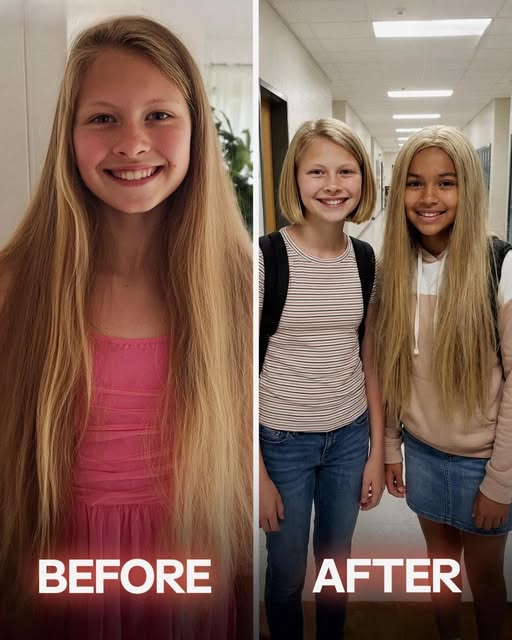
Letty’s impulsive act—the decision to cut her hair for a classmate named Millie, a girl fighting cancer—had done something unexpected. It had reached further than a school hallway or a moment of childhood bravery. It had pulled Jonathan’s old crew away from the refinery, out of their routines and into this office, as if something in them had been waiting for exactly this kind of call. They carried his hard hat like it still belonged in his hands, they spoke his stories like they were unfinished sentences, and they revealed a fund he had started long before any of them were ready to lose him. A fund meant for families drowning under medical bills, for people who had nowhere left to turn.
Millie’s mother, Jenna, stood frozen when the truth surfaced. The men explained that the “Keep Going Fund”—Jonathan’s idea, Jonathan’s quiet insistence—was never meant to sit unused or forgotten. It was meant for moments like this. For children like Millie. For families like hers. Piper listened, then stepped forward, her voice steady in a way she hadn’t felt in months, and refused to let Jenna turn away from it.
And then the school’s story began to crack open as well.
As details of Millie’s bullying finally came to light, no longer softened or hidden behind careful language, Piper’s grief sharpened into something else entirely. She demanded answers. She demanded accountability. Not polite promises or procedural reassurances, but real, visible change—something that would make it harder for another child to be left alone in the same way.
Around her, Jonathan’s friends didn’t leave. They didn’t hover awkwardly at the edges the way strangers usually do in moments of family crisis. They stayed close, forming a kind of quiet shield around Piper and Letty, offering a presence that felt almost instinctive, as if they had always known their place in this moment. It was the kind of protection Jonathan had once promised would exist for his family, even if he wasn’t there to provide it himself.
In the hallway, later, Piper found the letter.
Jonathan’s handwriting—familiar enough to hurt—spoke to her as if no time had passed at all. It told her not to close herself off, not to let grief turn into isolation. It reminded her, in the simplest possible way, that love wasn’t meant to end where life did.
That night, the house no longer felt empty in the same way. Millie and her mother were coming for dinner. Letty sat quietly, holding her father’s hard hat as if it still carried warmth. And Piper finally understood something she had been circling for months without being able to name it.
Grief hadn’t left. It never truly would. But it had changed shape. It had widened, stretched into something larger than loss alone.
Jonathan’s love was still here—not as memory, but as motion. It was moving through the people he had chosen as family, through the men who still wore his name, through a child’s unexpected act of courage. And somehow, against everything she thought she knew about endings, it was finding its way home.