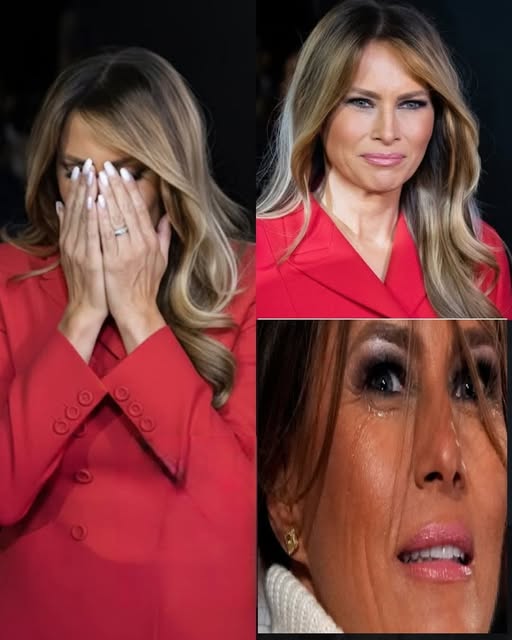
Melania Trump’s words did not arrive with force or spectacle, yet they landed with a quiet intensity that felt almost unbearable. They carried the weight of a moment that no one was prepared for—a moment when time seemed to fracture. A young father’s life was taken in an instant. A packed auditorium, once alive with energy and anticipation, became a chamber of shock, its echoes filled not with applause but with confusion and fear. Beyond those walls, an entire nation was left grappling with a grief it could not easily name, staring into a darkness that felt both distant and deeply personal.
In homes far removed from the scene, the consequences began to unfold in quieter, more intimate ways. Children will grow up reaching for a voice that will never answer them again, piecing together memories from stories told by others and photographs frozen in time. A wife will lie awake in the stillness of night, confronting an absence so profound that no promise, no shared history, could ever fill it. What was once ordinary—the sound of footsteps, a familiar laugh, a simple conversation—has been replaced by a silence that feels heavy, almost tangible.
The assassination of Charlie Kirk sent shockwaves far beyond Utah Valley University. Thousands witnessed the unthinkable in real time, their lives forever marked by a single, irreversible moment. Yet amid the noise, the speculation, and the public outcry, it was Melania Trump’s restrained and deeply human response that cut through everything else. She did not turn to politics or rhetoric. Instead, she chose to speak about loss in its most human form.
She spoke of children who will search for their father not in the present, but in fragments of the past. She spoke of a home that will never again sound the way it once did, where even the smallest details—a chair left empty, a room left quiet—become constant reminders of what has been taken. She spoke of laughter, once effortless and abundant, now replaced by a silence that lingers long after the headlines fade.
In her tribute, Kirk was not defined by public perception or political identity, but by the roles that mattered most in the privacy of his life. He was described as a husband who returned home weary but attentive, a father who made time to listen, to kneel down, to truly be present. He was portrayed as someone who believed that love of country was not an abstract ideal, but something rooted in the way one loved and cared for their family.
By shifting the focus in this way, Melania Trump reframed the tragedy. What could have remained a distant, polarizing event became something immediate and deeply personal. Her words served as a reminder that behind every public figure is a private world—one filled with relationships, responsibilities, and quiet moments that rarely make headlines but define a life.
In calling on Americans to respond not with division but with compassion and awareness, her message became more than a tribute. It became a plea—an appeal to recognize one another’s humanity before it is too late. It urged people to look beyond labels, beyond arguments, and to remember the fragile, shared reality that binds everyone together.
In the end, her words did not attempt to resolve the darkness or explain it away. Instead, they asked something simpler, yet far more difficult: to truly see one another, to value the presence of those we love while it still exists, and to hold onto that awareness in a world that can change in an instant.