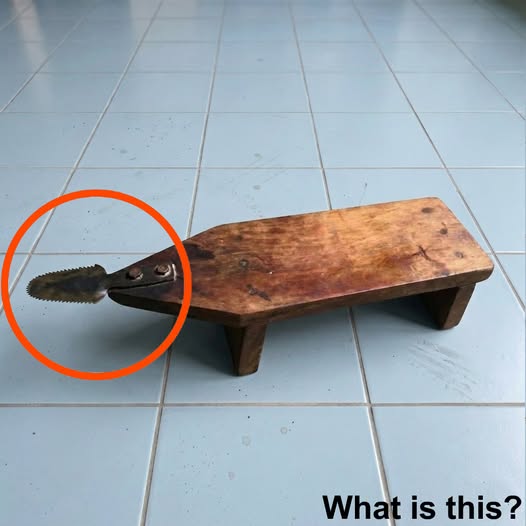
The first time we laid eyes on it, it didn’t feel like a simple object—it felt like a leftover fragment of a life we were never meant to understand. It was tucked away in a forgotten corner, half-swallowed by dust and silence, as if time itself had deliberately avoided touching it. There was something unsettling about the way it waited there, still and patient, as though it knew we would eventually come and try to make sense of it.
We stood around it for a long while before anyone dared to speak. Every angle we observed seemed to deepen the mystery rather than solve it. Its form was deceptively simple at first glance, yet the more we studied it, the more questions it raised. A tool? Perhaps. A weapon? Unlikely, but not impossible. Some kind of ritual instrument? Theories began to pile up, each one more uncertain than the last. We argued softly, half-amused, half-serious, tossing ideas back and forth as if words alone could unlock its purpose.
Then we pulled it into better light.
Dust drifted off its surface like it had been exhaling years of abandonment. Spider silk snapped and floated away. What emerged was a curious wooden structure—compact, sturdy, and strangely intentional in design. It had a low, stable base, almost like a seat, shaped to support a person’s weight. That alone shifted the conversation; it was clearly meant to be used, not merely displayed.
But it was the metal that truly held our attention.
Rising from one side was a jagged, unsettling piece of iron—small, curved, and lined with sharp teeth. They were evenly spaced yet aggressive in appearance, like something designed for cutting, tearing, or scraping. And yet, it didn’t resemble any tool we recognized from workshops or kitchens. It was too refined for rough lumber work, too precise for destruction, and oddly intimate in its scale. It didn’t feel industrial. It felt personal—almost domestic—like it belonged in someone’s daily routine rather than a battlefield or a factory.
We turned it over, examined its joints, traced its edges, and still came no closer to certainty. The more we tried to force logic onto it, the more elusive its purpose became. It was as if the object resisted interpretation, holding onto its secret with quiet confidence.
That was when memory stepped in where reasoning failed.
Someone mentioned our grandfather.
At first, it was just a passing remark—one of those nostalgic associations that doesn’t immediately mean anything. But then the stories came back in fragments: his journeys through distant towns, the small markets filled with unfamiliar tools, his habit of bringing home strange objects and demonstrating them with quiet pride. He had always enjoyed explaining things that seemed ordinary to him but mysterious to everyone else.
And then, like a puzzle piece sliding into place, someone remembered an old photograph from his village. In it, faint but unmistakable, was something that looked strikingly similar.
The realization shifted everything.
This was not a weapon. Not a machine part. Not a relic of violence or industry.
It was a coconut scraper.
Suddenly, the design made sense—not as something intimidating, but as something beautifully practical. You would sit on the wooden base, steady yourself, and bring a coconut toward the jagged metal teeth. With each careful motion, the firm white flesh would be shaved away in delicate curls, transforming something tough and whole into something usable, nourishing, and simple.
What once felt like a mystery carved from fear and speculation turned into something entirely different—a quiet tool from everyday life, shaped by tradition, patience, and necessity.
And in that moment, the object was no longer strange.
It was familiar in the most unexpected way.