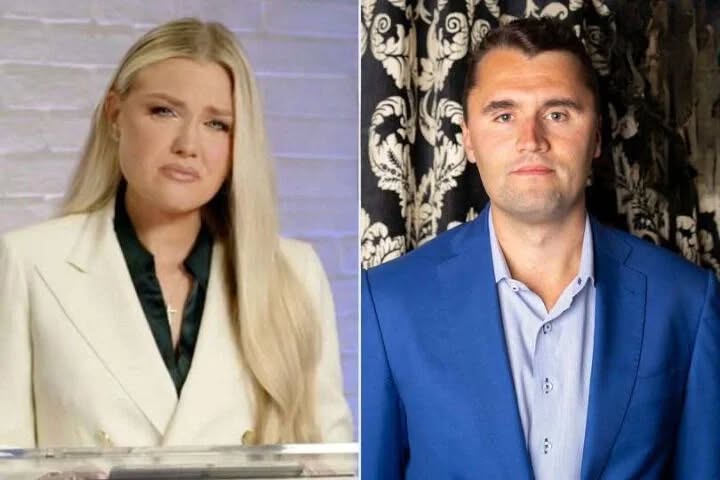
The announcement did not arrive quietly. It landed like a thunderclap across political circles, sending ripples far beyond the borders of Utah. With a single confirmation vote, a figure who had largely lived outside the national spotlight was suddenly thrust into the center of a heated national debate: the wife of conservative commentator Charlie Kirk.
Within hours, the decision ignited a political firestorm. Supporters framed it as a bold and overdue victory—proof that a new generation of conservative voices is stepping forward, ready to reshape public institutions with fresh energy and unapologetic conviction. Critics, however, reacted with alarm, warning that the move signals something more troubling: the steady blending of state governance with the ideological battles that dominate national politics.
Almost overnight, a name that had once circulated mainly in activist and media circles became the focus of headlines, commentary panels, and social media debates. Questions multiplied rapidly. What exactly does this appointment mean? What influence will she wield? And perhaps most importantly—what role will her powerful political connections play in shaping the office she now occupies?
Her rise in Utah has quickly become a reflection of the country’s deeper anxieties and ambitions. To many supporters, she represents the emergence of a new archetype in conservative leadership: women who step into positions of influence not through traditional political ladders but through a blend of grassroots activism, digital reach, and ideological clarity. In their view, this moment signals a generational shift—where political legitimacy is no longer defined solely by decades inside government halls but by the ability to mobilize communities and shape public conversation.
For these allies, her appointment is less about one individual and more about momentum. They see it as proof that the conservative movement is expanding its leadership bench and empowering voices that reflect its evolving identity. In that narrative, her background in advocacy and media is not a liability but a strength—evidence of someone who understands how modern political movements operate and communicate.
But to her critics, the same qualities raise red flags.
Opponents worry that the appointment represents the creeping politicization of roles that were once expected to remain more neutral or administrative. They fear that offices meant to serve the public could increasingly become extensions of national ideological struggles—platforms where cultural conflicts are amplified rather than resolved.
To them, the symbolism of the appointment looms larger than the job description itself.
The concern is not merely about one individual’s qualifications but about what the decision signals for the future of governance. If public offices become stages for partisan branding or ideological messaging, critics argue, the line between governance and activism begins to blur. And when that line fades, public trust can erode with it.
In this sense, the debate surrounding her rise has become far bigger than the office she now holds. It has evolved into a proxy battle over how political influence is built, who gets to wield it, and whether America’s deeply polarized national culture wars are now fully embedded in the machinery of state government.
Standing at the center of that storm, she now faces a delicate and defining moment.
The choices she makes in the months ahead will likely determine whether the initial uproar fades or intensifies. If she approaches the role with a focus on pragmatic, measurable improvements—policies and initiatives that directly benefit communities across Utah—she could gradually soften skepticism and demonstrate independence from the political narratives swirling around her.
Results, after all, have a way of reshaping perception.
But if the office becomes a platform for ideological confrontation, public messaging, or national political theater, the divide will only deepen. In that scenario, every decision could become another flashpoint in an already polarized environment, reinforcing the fears of those who see the appointment as part of a broader political strategy.
For now, the future remains unwritten.
What is clear is that she stands at a fragile crossroads—one where every action, statement, and policy choice will be scrutinized not only by the people of Utah but by observers across the country. In an era where political narratives travel faster than ever, even the smallest decision can echo far beyond state lines.
And so the spotlight remains fixed, the debate still burning, and the question lingering in the national conversation:
Will this moment mark the rise of a new kind of leadership—or the next escalation in America’s ever-intensifying political divide? 🔥🇺🇸