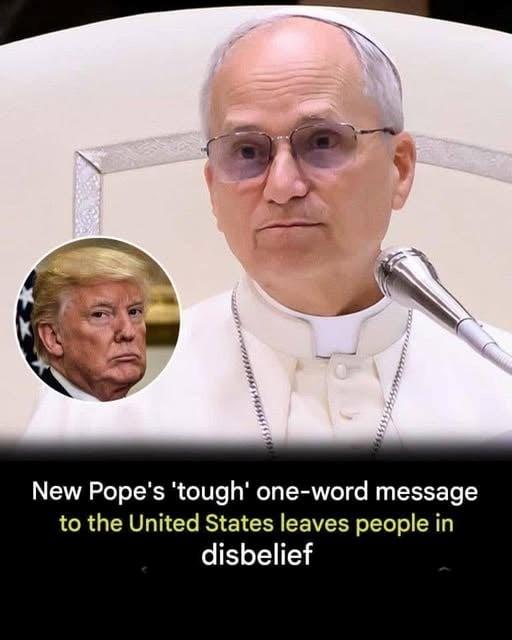
The world seemed to pause for a whisper. One word. Eight letters. A papal reply that cut through the noise, the fury, and the clamor of America’s chaos like a surgeon’s scalpel—precise, unsettling, impossible to ignore. As politicians shouted and pundits spun their theories into feverish webs, Pope Leo XIV spoke not a sermon, not a speech, but a single, deliberate word: “Many.”
It was not evasion. It was not a clever deflection. It was a verdict, a mirror, a summons. In one syllable, he held up a lens to a nation fraying at its edges, to a society tangled in its own contradictions, to a people wrestling with the sins of neglect, indifference, and pride. “Many.” It pierced the comfortable illusions and hollow reassurances. It was indictment, and yet, strangely, it was an invitation—to see, to reckon, to awaken.
The weight of that word came not from rhetoric but from experience. Leo XIV is no stranger to suffering. He has walked the scorched earth of refugee camps, knelt beside the dying, confronted the highest halls of power, and buried the overlooked and forgotten. He does not speak in platitudes. He does not pander to convenience or politics. In that one small word, he did more than count crises—he revealed their depth, their entanglement in the political, economic, and spiritual fabric of a nation teetering on the edge of its own illusions. He did not console. He confronted. He demanded that responsibility be reclaimed by the conscience of those who had grown comfortable in argument but reluctant in reflection.
Yet “Many” was not a sentence of despair. Hidden within it was the quiet hum of hope: many chances to rebuild, many hands willing to help, many hearts still capable of courage, many bridges yet to be crossed. It was a call to recognize abundance even amid fracture, potential even amid failure, connection even amid division. By saying so little, Leo XIV amplified the conversation—beyond the noise of campaigns, beyond the brevity of news cycles, beyond the endless chatter of opinion—to the enduring questions of the human soul.
And now, after the world caught its breath, after the echoes of that single word lingered like a bell in the stillness, the question is no longer, “Many what?” The question is sharper, more urgent: “How many more—how many more crises, how many more injustices, how many more moments of indifference—before we finally awaken and choose to change?”
In a whisper, a word, a pause, the Pope did what few dared: he reminded a nation that the reckoning is never far from the conscience, and that clarity, however brief, can cut deeper than a thousand speeches.