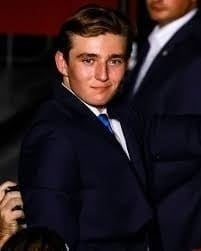
For eighteen years, America thought it knew Barron Trump. That quiet boy, the youngest in a family that commands headlines and controversy alike, the awkward shadow trailing a president—he seemed transparent, easily understood, harmless in his obscurity. But that assumption, like so many about him, was wrong. Barron was never just watching from the sidelines; he was observing, measuring, cataloging. Behind the polite nods, the hesitant smiles, the carefully edited public appearances, there was a mind at work, a consciousness quietly resisting the story the world had written for him.
Now, as he stands on the precipice of adulthood, Barron has broken the silence that has defined him for nearly two decades—not with tantrum, spectacle, or defiance, but with a calm, unsettling clarity. He is rejecting, in one measured gesture, the life that others planned out for him: no dynastic coronation, no predetermined political destiny, no rehearsed path of inherited power. Instead, he asserts something infinitely more radical: the right to exist on his own terms, in his own time, behind doors the public is not meant to open.
This emergence is not loud. It is not performative. And therein lies its quiet but disarming power. In a culture obsessed with access, immediacy, and the constant consumption of private lives, Barron’s refusal is almost revolutionary. He refuses the script that has shadowed him since birth—the heir, the symbol, the inevitable next-generation combatant in America’s unending political battles. He claims something more radical: the right to ambiguity, to unfinished stories, to a future that refuses to bend to public expectation or partisan fantasy.
What makes Barron’s stance resonate is its emotional precision. He does not shy away from the legacy of his last name. He does not pretend it is ordinary, nor attempt to evade its weight. He confronts it, acknowledges it, and then deliberately refuses to be crushed beneath it. In a society that monetizes every gesture of the powerful, that exploits every photograph, every syllable, every idle moment of those born into prominence, Barron chooses something astonishing: disappearance over performance, depth over visibility, self-possession over spectacle.
His message is quiet, yet it reverberates like a hammer striking glass: you may know the name, but you do not own the person who bears it. For the first time, the world sees that the youngest Trump is no cipher, no footnote, no accessory to a family narrative. He is Barron—complex, deliberate, untouchable in ways that unsettle our hunger for access and certainty. And in that refusal, he has already rewritten the story the world thought it was telling about him.