Silence had become his only companion.
It didn’t arrive all at once—it settled in over five long years, layer by layer, until it filled every corner of his life like dust that refused to be wiped away. It lived in the spaces between ticking seconds, in the echo of footsteps that no longer came down the hallway, in the chair that never shifted again. His world shrank slowly, painfully, until it fit inside the frame of a crooked calendar pinned to the wall, a half-empty garage that once held laughter instead of tools, and the memory of a door that closed one day and never opened again.
He stopped measuring time in days. He measured it in absences.
Then, on a Tuesday that looked no different from any other, something changed.
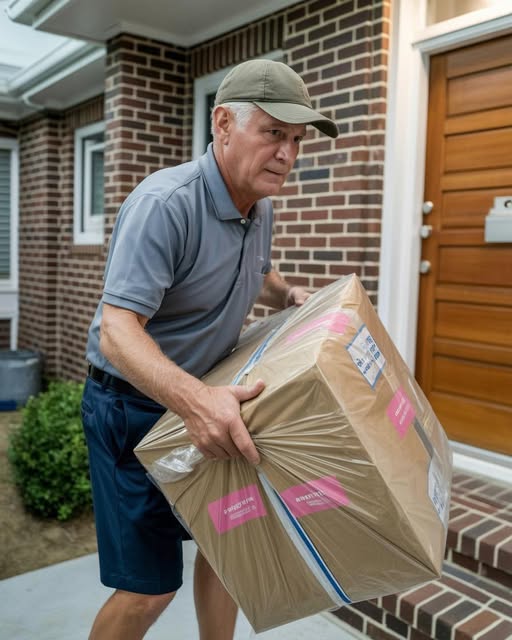
The knock never came. There was only the delivery—sudden, impersonal, almost cruel in its simplicity. A cardboard box sat on his doorstep like it had always belonged there, waiting for him to become the kind of man who would finally open it. No return address. No explanation. Just weight. Just presence. And beneath it all, a faint, unfamiliar scent—oil, metal, and something distant, like memory itself trying to find its way back home.
He stood there for a long time before he touched it.
When he finally brought it inside, his hands moved like they belonged to someone else. Careful. Hesitant. Expecting punishment, or closure, or some final piece of a story he had already given up on finishing. Maybe old photographs meant to reopen wounds. Maybe broken parts of something they had once built together, now returned as evidence that nothing could ever be repaired.
Because that was what he believed it would be—an ending delivered in cardboard.
But it wasn’t an ending at all.
Beneath layers of packing foam and folded paper, there was metal. Heavy. Real. Waiting. An engine block—painted in deep Ford racing blue—sat revealed like a buried heartbeat brought back into the light. It wasn’t just machinery. It was memory made tangible. The very soul of the Mustang they had once sworn, years ago in a different life, to rebuild side by side. A promise spoken in optimism, half-finished and abandoned when life turned sharp and unforgiving.
Now it sat in his garage like it had been patient all along, like time had simply stepped away and left it there to endure in silence.
He reached out and touched it.
It was cold. But it felt alive.
His breath caught—not from the weight of the engine, but from the weight of everything it carried. Every unfinished conversation. Every slammed door. Every word he had rehearsed but never said. The engine didn’t just hum with mechanical history; it hummed with years of distance, stubborn pride, and love that had never found the right sentence to come home.
And then he saw the letter.
Folded carefully. Simple. No theatrics. Just two words that seemed to shake the air around him:
Dear Dad.
There was no anger in it. No accusations sharpened into ink. Only honesty—fragile, deliberate, and hard-won. It spoke of mistakes without drowning in them, of years spent learning how to carry regret without letting it crush the person underneath. It was not a demand for forgiveness. It was something rarer. A bridge. Carefully built plank by plank from memory, silence, and the quiet courage it takes to reach across a broken past.
He read it once.
Then again.
And then he couldn’t breathe for a moment.
Alongside the letter lay a photograph.
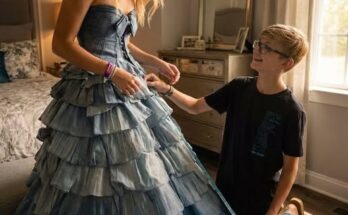
Grace.
Older now. Changed. Strong in a way that didn’t ask permission. In her arms, a newborn son—small, impossibly new, his life just beginning while another chapter was still trying to heal. Her eyes in the photo held something he hadn’t seen in years. Not resentment. Not distance. Something softer. Something dangerously close to hope.
And beneath it all, a plane ticket.
His name printed clearly on the paper, as if it had always belonged there waiting to be claimed.
The house around him felt different after that. Not emptier—but rearranged. As if the silence itself had shifted to make room for possibility. He looked at the crooked calendar on the wall, then at the engine, then at his own hands—hands that had stopped building anything years ago.
Slowly, he straightened the calendar.
Then he opened a drawer he hadn’t touched in years.
And for the first time in a long time, he packed a bag.
Because some engines don’t stop forever.
Some fathers don’t either.
They just wait—quietly, stubbornly—until someone, somewhere, finally turns the key.