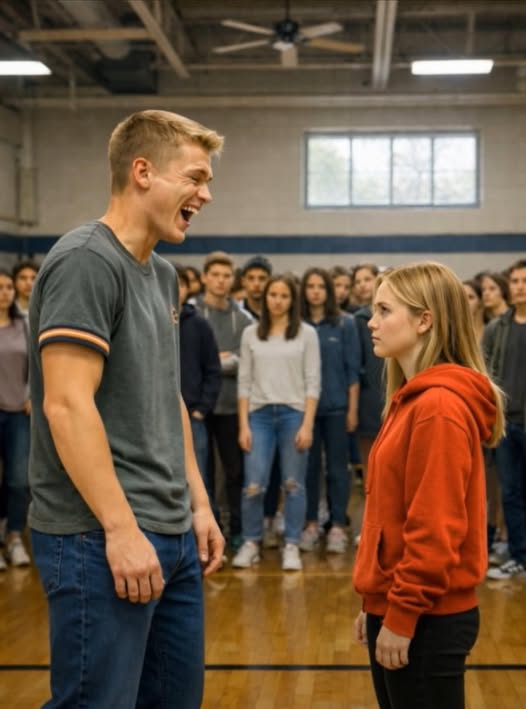
The hallway seemed to hold its breath the moment her voice broke through the thick, familiar silence. It wasn’t loud, yet it carried with it the weight of years—years of ignored warnings, buried complaints, and quiet suffering that had been carefully pushed out of sight. Conversations died mid-sentence. A locker door stayed half-open. Even the fluorescent lights above seemed to flicker in hesitation.
Every secret that had been swept under rugs and rewritten into harmless reports began to rise all at once, like a tide finally breaking free of its walls. The air tightened. A few students instinctively stepped back. Somewhere down the corridor, a chair scraped against the floor and stopped abruptly, as if even sound had become dangerous.
When she said his name—and then her own title—something shifted in the room. His laugh, sharp and confident only seconds before, fractured in disbelief. Teachers who had perfected the art of not seeing suddenly found no safe place for their eyes. Phones lifted quietly, not for gossip now, but for evidence. In that fragile stretch of seconds, reputations, policies, and carefully maintained denials hung suspended, waiting to fall depending on what she said next.
Anna Martinez had spent most of her school life learning how to be invisible.
She understood the geography of avoidance better than anyone—the blind spots near the stairwell, the timing of hallway rotations, the exact moments teachers would look past what they didn’t want to understand. She moved like a shadow through it all, watching Marcus “Tank” Rodriguez carve fear into the edges of the school while authority figures adjusted their narratives to keep everything “manageable.”
The breaking point hadn’t been dramatic at first. It was administrative. A simple report. Kevin Chen’s fractured arm had been quietly reduced to an “unfortunate accident,” the kind of language designed to close conversations rather than open them. That was the moment Anna stopped believing the system was broken by oversight. She realized it was broken by design—or at least protected by choice.
After that, fear no longer stayed in its original form. It didn’t disappear; it evolved. It sharpened. Anna stopped being afraid only of Tank’s violence and started being afraid of what would happen if nothing ever interrupted it. Silence, she realized, was not neutral—it was complicit.
So she began to collect the truth the way others collected excuses.
Dates scribbled in the margins of notebooks. Injuries matched with timestamps. Whispers overheard in faculty rooms when adults thought students weren’t listening. Emails carefully worded to sound responsible while saying nothing at all. Every piece of it became part of a record she built quietly, patiently, like assembling proof of something everyone pretended wasn’t happening.
And when Marcus finally turned his attention toward her—when she became just another target in his pattern—something inside her stopped retreating.
That was the moment she chose not survival, but exposure.
In front of a hallway full of witnesses, she let the truth unfold with controlled precision. She named the victims who had been erased from official memory. She repeated the words that had been softened, distorted, or buried entirely. And then she revealed the part no one expected: she was not alone, not unprotected, and not just a student speaking into a void. She had been working with the Youth Crime Prevention Unit the entire time.
The change was immediate.
Footsteps echoed from both ends of the corridor as authorities moved in. The careful balance the school had maintained for years finally cracked under its own weight. Whispers turned into shock. Shock turned into realization. And for the first time, the system that had survived by silence was forced into something it had long avoided—accountability.
This time, no one was allowed to look away.