Consciousness didn’t gently return—it detonated.
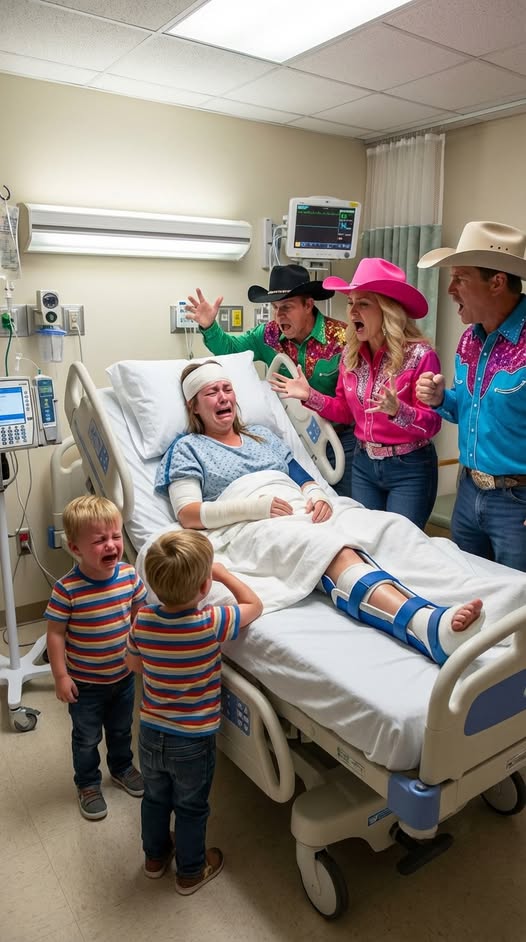
There was no slow climb back into awareness, no soft fade from darkness into light. One moment I was nothing but weightless anesthetic void, suspended somewhere beyond pain and thought. The next, I was awake—too awake—trapped in a hospital bed while the world I thought I understood was quietly collapsing somewhere far beyond those sterile walls.
A voicemail was playing.
At first, I couldn’t even place it. Just a voice. Cheerful. Familiar in the worst possible way. Then meaning arrived all at once, sharp and unforgiving, as if my brain had been waiting for permission to break.
My parents.
Their words were calm, almost proud. They spoke about my “generous contribution” like it was a casual gift, like I had willingly signed away pieces of my life for applause that never came. Only it wasn’t a contribution. It was my home. My future. My safety net. Gone.
Sold.
While I was unconscious on an operating table—my spine literally cracked open, held together by screws and hope—they had taken everything I had built. Eight years of grinding work. Double shifts that blurred into exhaustion. Holidays I refused to take. Meals I rushed through. Dreams postponed indefinitely under the weight of obligation dressed up as family duty.
All of it, quietly converted into something I was never asked to approve.
A wedding.
Not even a modest one. A spectacle. Six hours of chandeliers, champagne, and performance—paid for with the life I had not consented to surrender.
And I hadn’t even been invited to plan it.
That was the part that didn’t make sense at first. The betrayal wasn’t just financial. It was procedural. As if I had never been a person in the equation at all—only a resource. Something to be used, then thanked, then forgotten.
They expected gratitude when I woke up. They expected confusion. Maybe even silence. They assumed anesthesia and pain medication would dull me enough that I wouldn’t notice the empty space where my life used to be. The missing keys. The altered accounts. The final, irreversible absence of my home.
But they forgot something.
I woke up.
And I listened.
I replayed the voicemail again while the stitches in my back burned like live wire beneath my skin. My father’s tone never changed. Still warm. Still proud. Still completely unaware that every word was unraveling something permanent inside me.
“Your generous contribution…”
No apology. No hesitation. Just certainty.
That’s when it clicked—not as a single moment, but as a pattern I had been too loyal, too exhausted, too conditioned to name.
The “loans” that were never loans.
The favors that always came with invisible interest.
The guilt that arrived neatly packaged whenever I tried to say no.
The way every act of love was quietly converted into a ledger I was always destined to lose.
I wasn’t a daughter in their story.
I was funding.
I lay there staring at the ceiling tiles, counting the faint cracks in them as if they could anchor me to something real. My hands trembled, not from medication, but from recognition. Not of what they had done—but of what I had allowed myself to ignore in the name of family.
And then I did something they never expected.
I reached for my phone.
There was a lawyer—someone I had once quietly trusted with a precaution I never spoke about out loud. Years earlier, in a rare moment of clarity, I had ensured the deed to the property was protected. Not out of paranoia. Out of instinct. A single line of legal foresight buried under years of trying to convince myself that love and fairness would eventually align.
They hadn’t.
But that document had.
While they were laughing under lights they believed symbolized victory, while guests raised glasses to a celebration built on my absence, the call was already in motion. Quiet. Precise. Irreversible.
The sale was frozen.
The transfer challenged.
The illusion cracked open.
And somewhere, miles away in a hall full of music and expensive lies, the truth began to enter the room like a cold draft no one could ignore.
I didn’t see it happen. I didn’t need to.
I imagined it—the moment confusion replaces celebration. The way smiles falter when conversations collide. The instant someone realizes the foundation beneath the entire event is no longer secure.
I turned off the voicemail before it could play again.
No shouting followed me. No confrontation. No final speech.
There was only the slow, careful movement of someone learning how to exist without permission.
I swung my legs over the side of the hospital bed, every movement pulling at stitched muscle, every breath a reminder that I was still alive in a body they had treated as collateral.
And as I stood there—unsteady, aching, but finally clear—I understood something with absolute certainty:
They had taken my house.
But they had not taken me.
And for the first time in years, that distinction was everything.