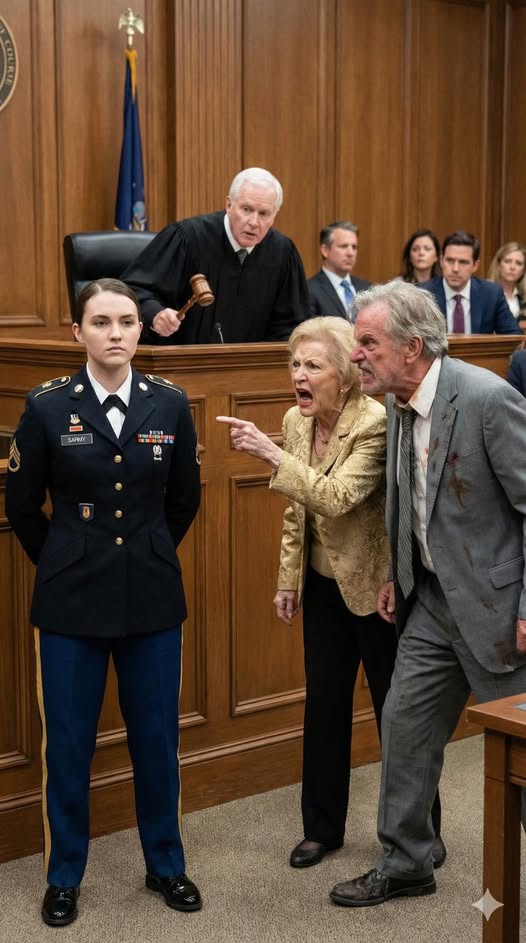
The gavel never saved her—not the first time it fell, not the second, and not even when she had once believed, foolishly, that justice might eventually learn her name.
This courtroom was built like so many others: polished wood, high ceilings, and a quiet that pretended to be dignity while it slowly pressed the life out of anyone without power. It was a place where people came to be believed too late, if at all. And today, in that same room that had swallowed so many forgotten stories, an old case that was supposed to stay buried began to breathe again.
It didn’t start with a bang. It started with hesitation. A pause too long before a name was called. A judge who looked suddenly older under the weight of a file he clearly remembered more than he wanted to admit. And then, like a crack spreading through glass, everything began to fracture.
Old bribes resurfaced in careful legal language. Sealed documents that were never meant to see daylight were opened like wounds. A starving child once seen only as “irrelevant background detail” on 42nd Street became the center of something far larger than anyone in that room had prepared to face. Every buried sin—every signature, every payment, every quiet agreement made behind closed doors—began clawing its way back into the light.
And the man on the bench… the man who had once believed himself untouchable in his robe of authority… dropped his mask piece by piece as the evidence unfolded.
They had told themselves it was simple. A will. An inheritance. Money, neatly divided on paper. Something to be contested, delayed, manipulated—dragged through courts by lawyers who charged more in an hour than her mother had earned in a month of exhausting labor. They thought it would be easy to erase her with procedure. To outlast her with paperwork. To bury truth under billing statements and forged signatures so carefully crafted they almost looked like mercy.
But they didn’t notice the smallest details at first.
The way the judge’s hand trembled when her full name appeared on the record.
The way silence spread through the gallery—not the respectful kind, but the kind that arrives when people realize they are witnessing something that will not stay contained.
Even the fluorescent lights seemed louder, buzzing overhead like insects trapped in a sealed jar, as if the building itself was nervous about what it was being forced to remember.
Her grandfather’s final act, they had always claimed, was generosity. A distribution of assets. A tidy ending to a complicated life.
But that wasn’t true.
It was an indictment.
Written in precise legal language, yes—but underneath it, something sharper. Memory. Accusation. Evidence encoded in clauses and footnotes that only revealed themselves when the right hands finally turned the right pages.
When the files were unsealed and the recordings were played aloud in open court, the entire room shifted—literally and emotionally—as if the floor could no longer hold the weight of what was being exposed.
Her childhood stopped being a vague tragedy people whispered about in uncomfortable tones. It became what it had always been beneath the silence: a documented pattern of neglect, exploitation, and erased responsibility. A crime scene disguised as a family history.
She watched them then—the architects of her suffering—as their composure finally failed. Not in dramatic outbursts, but in the far more honest language of collapse: lowered eyes, shaking hands, papers slipping from fingers that suddenly didn’t know what to do with themselves anymore.
Each page turned was another reflection breaking.
Each recording played was another truth they had spent years trying to suffocate.
And in the middle of it all, she felt something shift inside her—slow, irreversible, and far deeper than anger. Not forgiveness. Not relief. Something cleaner and more dangerous: clarity.
Because apology, she realized, was never going to reach the place where this pain had lived.
When it was over, she didn’t feel like someone who had won a case.
She felt like someone who had survived a system that had finally been forced to look at itself without blinking.
She walked out of that courtroom carrying more than a settlement. She carried proof. She carried a name that now meant something no one in that room could undo. She carried ownership of what had once been stolen from her in silence.
And as the doors closed behind her, she made a promise—not spoken loudly, but written into the way she stood, the way she breathed, the way she refused to look back.
No more children would stand where she had stood.
No more voices would be reduced to echoes in a room that mistook power for justice.
And if the gavel would not save the powerless…
Then she would learn how to make sure it could no longer ignore them.