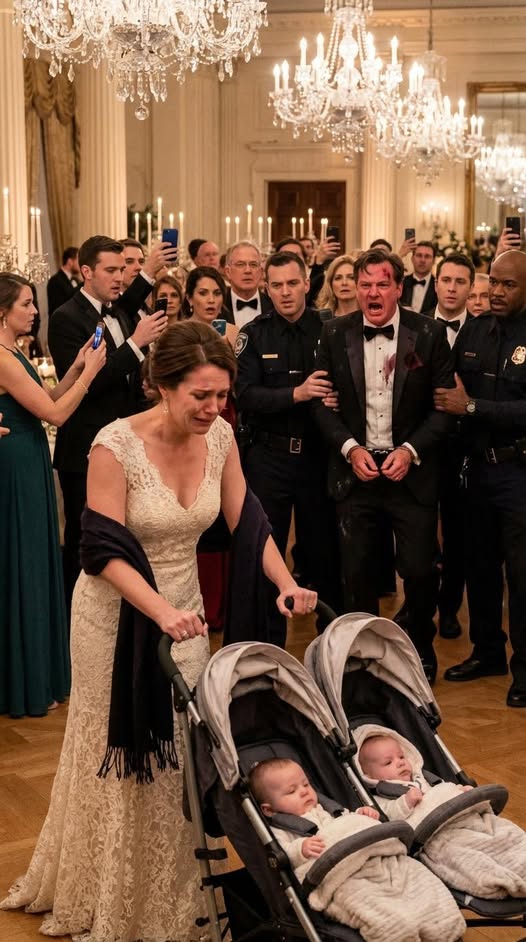
The silk of my dress cut across the scar on my arm, a sharp, almost ironic sting, while my husband’s voice floated over the clinking of crystal and the rehearsed hum of polite laughter. “She’s a liability,” he said, with that practiced half-smile that had always tried to convince the room—and himself—that everything was under control. Around him, friends, colleagues, and distant relatives nodded, oblivious, their attention split between his polished words and the sparkle of champagne. They thought I was nothing more than a backdrop, a prop, a mother with spit-up dribbled onto her shoulder, a figure who existed solely to be smiled at, photographed, and forgotten.
They didn’t know. No one did. Beneath every signature, every title, every carefully drafted clause, a different reality pulsed—quiet, deliberate, immovable. I had spent years stitching it together, a lattice of contracts, authorizations, and accounts that no smiling speech or self-congratulatory toast could ever undo. While he practiced his vision for the room, I had been preparing for the moment when reality would catch up with his fantasy.
He had rehearsed that speech so many times he didn’t even notice who had paid for the microphone. He didn’t see the cameras that weren’t meant for him. He didn’t realize that his empire was built on cards, accounts, and access points that I controlled. As he toasted his own reflection in the mirror behind the bar, I was on the cold hotel floor, twins bundled against my chest, my laptop open and humming quietly. Every single file, every account, every legal instrument had already been rerouted to its rightful owner: me. The pings of revoked access, the frozen credit lines, the denied privileges—they weren’t revenge. They were corrections, the steady, precise restoration of order. One by one, I watched the illusion he had built for decades evaporate from his hands like mist he had mistaken for marble.
When the Board finally played my recorded statement, the room went still. They didn’t see a wife standing there. They saw the majority shareholder they had overlooked for years, the woman who had been quietly building, quietly waiting, quietly ensuring that when the time came, she could not be ignored. I walked in wearing the very dress he had mocked, a baby cradled against my hip, eyes steady, voice unshakable. And in a single, deliberate vote, I ended his fantasy, closing the chapter he thought he had written.
Months later, I passed him on a crowded city street. His gaze flicked to me—perhaps seeking triumph, perhaps expecting a shadow of fear—but he found none. There was no gloating, no satisfaction, only the expansive, clean relief of someone who had reclaimed her life, her name, her children, and her power. It was not loud. It was not dramatic. It was the quiet, unassailable authority of someone who had been underestimated her whole life and had, at last, arranged the world exactly as it was always meant to be.
I went home that evening to my children, to rooms filled with laughter instead of whispers, to a life shaped around my own steady, immovable strength. And for the first time in years, I felt entirely, impossibly, free.