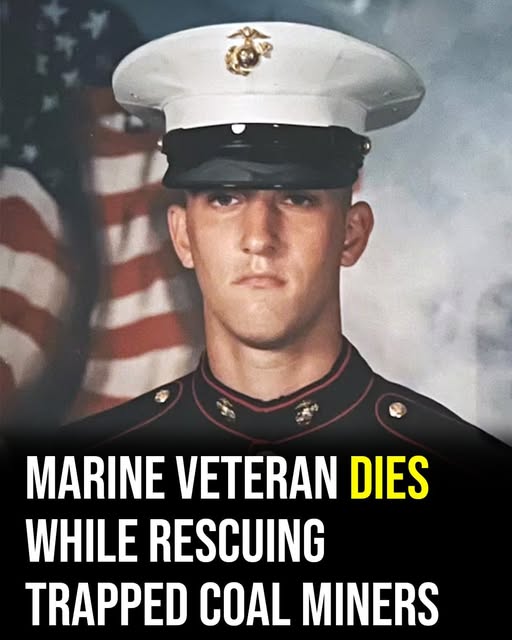
A Marine who once cheated death in the shattered streets of Fallujah stepped into a coal mine in West Virginia and never came back out. It wasn’t a battlefield this time. No enemy in sight. Just rock, darkness, and the fragile line between safety and catastrophe. Then, in a single, unforgiving moment, that line broke—one wall giving way, one thunderous surge of water turning the mine into a trap.
Men shouted. Lights shook. Instinct took over.
Some ran.
But Steven Lipscomb turned back.
In the chaos—where every second meant the difference between life and death—he made the same choice he had made years before under fire: he moved toward the danger, not away from it. Toward the men who hadn’t made it out yet. Toward the ones still counting on someone to come back for them.
That decision would be his last.
Steven M. Lipscomb’s final moments were not an exception to who he was—they were the purest reflection of it. His life had always followed the same quiet, unshakable pattern: if there was risk to bear, he would carry it. If there was a harder path, he would take it. If someone else needed a chance to make it home, he would give them his.
Years earlier, in Fallujah, he had already stared death in the face. A roadside bomb tore through the silence, leaving destruction in its wake—but somehow, Steven walked away. That day, his courage earned him a Purple Heart. But medals never defined him. Survival never made him step back. If anything, it only seemed to deepen the way he lived afterward—with more purpose, more presence, more willingness to stand where others couldn’t.
And in that West Virginia mine, when the walls failed and the water came roaring in, he didn’t hesitate.
Seventeen men made it out because he stayed.
Seventeen families were spared the knock at the door.
Seventeen lives continued forward—because Steven Lipscomb chose, once again, to be the one who didn’t leave.
Those who worked beside him don’t talk about grand speeches or dramatic commands. They remember something quieter, something rarer: a man who didn’t need to raise his voice to lead. In the worst moments, when panic threatened to take over, Steven’s calm steadiness became an anchor. When he said they’d get through it, people believed him—not because he demanded it, but because he lived it.
He was the kind of leader who made fear feel smaller just by standing there.
But beyond the helmet, beyond the uniform, beyond the mine—he was simply Steve.
At home, he wasn’t a hero. He was Dad.
He was the one who showed up—no matter how long the shift, no matter how heavy the day. The one who coached, who listened, who sat through practices and games with quiet pride. The one who carried the weight of his work underground but never let it follow him through the front door. For Heather, for Greer, for Stella, he was the center of everything steady and safe—a presence so constant it felt unbreakable.
Until it wasn’t.
Now, what remains is not just the story of how he died, but the far more powerful truth of how he lived.
A legacy built not on a single act, but on a lifetime of choices—small, consistent, and unshakably selfless. The choice to go back for the last man. The choice to take the harder post. The choice to stay one minute longer when it mattered most.
Leaders will call him a hero. And they won’t be wrong.
But for the family he left behind, that word will always fall short.
Because to them, he wasn’t just a man who saved lives.
He was the life they built everything around—the voice in the next room, the steady hand, the promise that no matter how hard the world became, he would be there.
And in the end, the very instinct that made him that man—the refusal to walk away when someone else needed him—was the same one that took him from them.
Not lost.
Given.