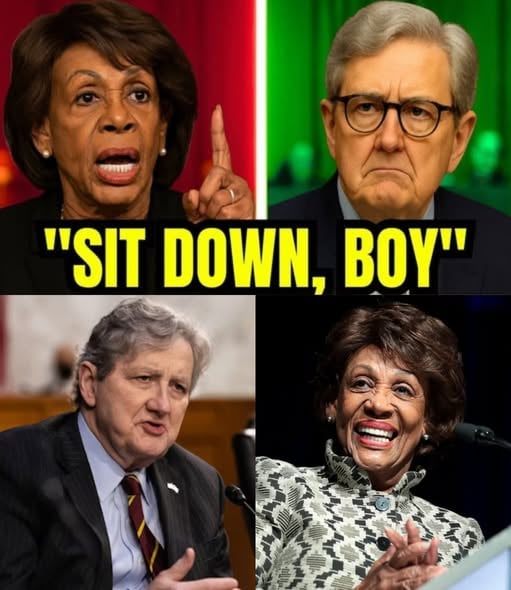
Waters didn’t just speak—she detonated the room. Her words were not mere syllables, not a polite challenge or a pointed critique; they were explosives wrapped in velvet, and the moment she let them loose, the very air seemed to shiver. One command, one single phrase, and it was as if history itself had leaned forward, curious, eager, ready to witness the unfolding. Cameras faltered, microphones caught a static hum, and the usual hum of anticipation stilled into an almost sacred silence. Kennedy lifted his glasses slowly, deliberately, like a man stepping into a storm he could neither avoid nor control. His eyes were steady, yet behind them simmered the unspoken possibility of eruption—he could have cracked, could have lashed out, could have let the room explode around him. And yet, he didn’t.
What happened next didn’t merely answer Waters—it reversed the momentum of the moment. It didn’t just respond; it upended. The power in the room shifted subtly but unmistakably. What made that instant unforgettable wasn’t just the sting of Waters’ words, but the sheer weight behind them. Every syllable carried the echoes of generations: pain, defiance, the persistent pushback against authority that had long sought to silence voices like hers. “Sit down, boy.” It was deceptively simple, yet it resonated like a bell tolling over centuries of injustice and confrontation. For a heart-stopping moment, it felt as though every unresolved argument about race, power, and respect had been dragged into that room and laid bare, suspended between them like fragile glass. The air thickened, heavy with expectation, as every gaze fixed on Kennedy, waiting, almost collectively holding its breath, for the eruption that might have shattered the room.
And then—he chose something entirely unexpected. Control. Composure. Not the explosive reaction that might have been anticipated, but something quieter, far more powerful. His reply, calm and deliberate, did not erase the tension; it redirected it, reshaping it. By refusing to meet fire with fire, he revealed a different, almost unsettling kind of strength—the kind that does not announce itself with volume or aggression, but with the quiet insistence of presence. The moment became less about insult, less about immediate victory, and more about the weight each person carried in their posture, their gaze, their very bearing. In that precarious balance of command and restraint, both Waters and Kennedy laid bare the intricate dance of power in modern politics. Power, they showed, is not merely what you declare in the heat of a moment—but how you choose to occupy the space around it, how you decide to stand, unmoving yet unshaken, as the world leans in to watch.