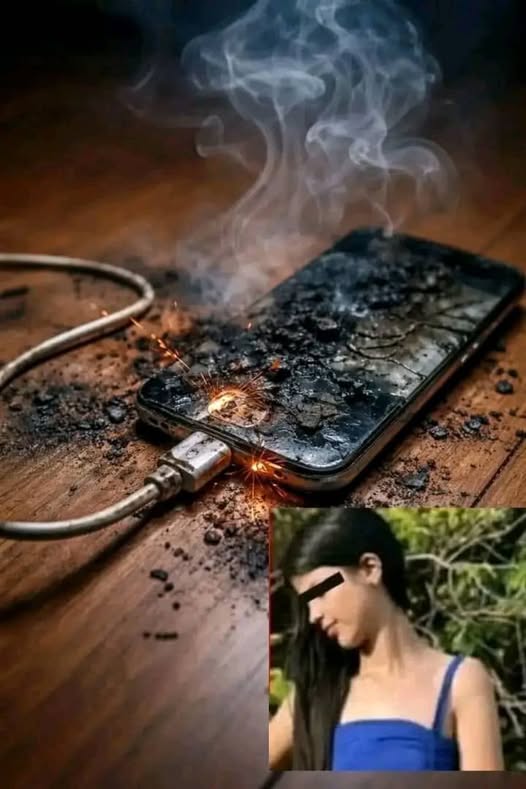
Charging your phone feels completely harmless—almost automatic, something you do half-asleep without a second thought. You plug it in, set it down, and move on with your life. But behind that everyday routine is a quiet flow of high electrical power being pushed through a thin cable and a small adapter—systems that only remain safe when everything is working exactly as intended.
The danger doesn’t usually announce itself. It doesn’t start with something dramatic. It begins with the small things people tend to ignore: a charger bought for a few dollars too cheap to be certified, a cable that has been bent and twisted one time too many, a loose connection that only sparks occasionally, or an outlet crowded with adapters because “it still seems to work fine.”
And then there are the habits that feel harmless in the moment—charging a phone under a pillow while watching videos in bed, leaving it plugged in overnight on a soft surface, or stacking extension cords behind furniture where heat has nowhere to escape. Each of these conditions quietly adds stress to the system.
Inside a damaged or low-quality cable, insulation can start to break down. Wires that should be neatly separated may begin to touch. Heat builds up in places you can’t see. Plastic components slowly weaken, soften, and deform. What starts as a minor electrical inefficiency can escalate into something far more dangerous: a hotspot forming inside the charger, a sudden spark, or in the worst cases, ignition.
What makes this especially unsettling is how unremarkable most warning signs are. Many incidents don’t begin with flames—they begin with silence. A charger that feels unusually warm. A faint buzzing near the outlet. A plug that no longer sits firmly in the socket. Often, these are dismissed as minor annoyances or “normal wear and tear,” when in reality, they can be early indicators that something is no longer safe.
Most small electrical incidents never become headline news. Instead, they end quietly: a melted plug discovered in the morning, a blackened wall socket behind a desk, or a charger that stops working after emitting a faint smell of burnt plastic. These moments rarely make noise, but they are clear signals that something went wrong long before the damage was visible.
The encouraging part is that the risks are almost entirely preventable. Using properly certified chargers, replacing frayed or stiff cables immediately, and avoiding cheap, unverified accessories dramatically reduces the chance of failure. Giving outlets space to breathe instead of burying them behind clutter helps heat dissipate safely. Avoiding overloaded multi-plug setups reduces strain on the electrical circuit. And perhaps most importantly, never charging devices under pillows, blankets, or anything that traps heat can make a critical difference.
Even something as simple as unplugging chargers when they’re not in use removes unnecessary load and reduces long-term wear.
Charging your phone will always be part of daily life—but it’s worth remembering that safety isn’t about fear, it’s about attention. The risks are rarely loud or obvious. They build slowly, quietly, in the background of routines we rarely question. And in that sense, your smallest habits—where you place a charger, what cable you use, how many devices share one outlet—can determine whether charging remains effortless or becomes something far more dangerous than anyone expects.