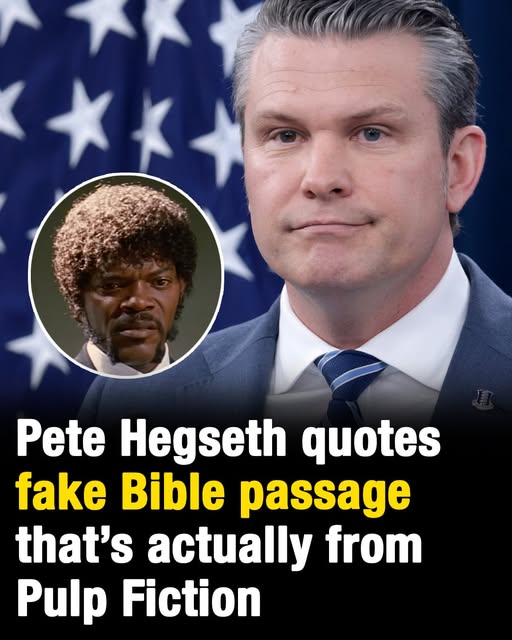
Pete Hegseth’s appearance inside the Pentagon chapel, intended to project solemnity and spiritual gravity, instead spiraled into a moment of unexpected national spectacle—one that quickly escaped the confines of the ceremony and erupted across the internet. What was framed as a prayer for fallen airmen and a blessing over military sacrifice soon became a cultural flashpoint, not for its reverence, but for its uncanny resemblance to a scene lifted from Pulp Fiction. The “Bible” prayer, delivered with intensity and theatrical force, was widely recognized not as ancient scripture or prophetic lamentation from Ezekiel, but as a near-direct echo of Samuel L. Jackson’s iconic cinematic monologue—complete with its rhythm, cadence, and thunderous moral declaration.
Within hours, social media platforms lit up with comparisons, memes, and disbelief. Clips circulated side-by-side with the film reference, and what was meant to be a sacred invocation was reframed as a striking example of how deeply pop culture now permeates even the most formal corridors of American power. For critics, the moment was more than just an embarrassing misquote—it became a symbol of what they see as a blurred boundary between performance and piety, where religious language is shaped as much by Hollywood scripts as by theology or tradition. In their view, the episode exposed a hollow performative strain of public faith, one that risks transforming prayer into theater at precisely the moments when sincerity and moral clarity matter most.
Supporters, however, pushed back quickly, with official explanations emphasizing that the language was “inspired” by both biblical themes and cinematic reference points, arguing that the intent was devotional rather than derivative. They dismissed the backlash as overblown and politically motivated, even characterizing parts of the online reaction as “fake news” amplified by critics eager to misinterpret the moment.
Yet beneath the humor, memes, and partisan back-and-forth lies a more uncomfortable question about the modern intersection of religion, media, and state power. When leaders invoke divine authority in the context of war, every phrase carries weight—not only for its spiritual meaning, but for its cultural origins and perceived authenticity. And when those sacred invocations become indistinguishable from Hollywood dialogue, the result is not just ridicule or confusion, but a deeper unease about where faith ends and performance begins, especially when real lives and real conflicts are at stake.