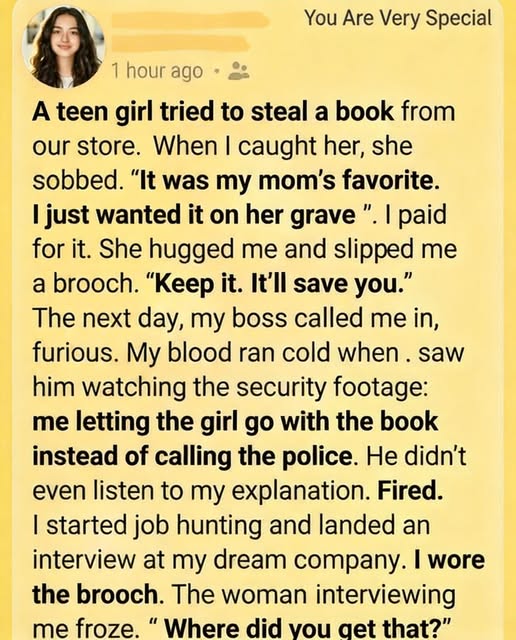
The girl’s hands were trembling when she slipped the book into her bag.
It was a small movement, quick and quiet, the kind people hope no one will notice. But I noticed. After eight years behind the counter of that little bookstore, I noticed everything—every hesitant glance, every lingering hand over a cover someone wished they could afford, every nervous step between the shelves.
She couldn’t have been more than sixteen. Her hoodie sleeves swallowed her hands as she zipped the bag shut, and for a second she just stood there, frozen, as if waiting for the world to collapse on top of her.
Our security camera caught everything.
And so did I.
The rule was simple. Clear. Non-negotiable.
Call security.
Every employee signed the same policy. Theft meant immediate reporting, no exceptions. I had followed that rule dozens of times before—sometimes with college kids, sometimes with adults who pretended not to care. Each time I told myself it was just policy, just business.
But something about this girl was different.
Maybe it was the way she kept glancing back at the shelf where the book had been. Maybe it was the way she looked less like a criminal and more like someone trying to rescue something she desperately needed.
I stepped out from behind the counter.
“Hey,” I said softly.
She flinched.
Her eyes darted toward the door, calculating the distance. I could almost hear the panic racing through her thoughts.
I didn’t mention the book.
Instead, I asked, “Is everything okay?”
For a moment she said nothing. Then her voice came out barely above a whisper.
“I’m sorry.”
That was all.
Just those two words.
And somehow they carried more weight than any excuse ever could.
I could have pressed the security button under the counter. One quiet click and the process would begin—reports, cameras reviewed, a lecture about consequences.
Instead, I sighed and said, “Bring the book here.”
Her face drained of color. Slowly, reluctantly, she pulled it from her bag.
It was a worn paperback—one of those quiet novels that never made bestseller lists but changed the lives of people who read them.
“I didn’t mean to steal,” she said quickly, tears gathering in her eyes. “I just… I don’t have the money right now, and I needed it for school, and—”
“You like reading?” I asked.
She nodded.
The answer was so small it almost disappeared.
Without another word, I took the book, scanned it at the register, and paid for it with my own card.
Then I slid it across the counter toward her.
Her eyes widened.
“You can’t—”
“I already did,” I said gently.
For a moment she just stared at the book, as if it were something fragile and impossible. Then she hugged it to her chest like it was oxygen.
Before she left, she unclipped something from her bag and placed it on the counter.
It was a small silver brooch shaped like a flower.
“I can’t pay you back,” she said. “But… this is all I have.”
I tried to refuse, but she insisted.
Then she slipped out the door, disappearing into the gray afternoon before I could even ask her name.
I pinned the brooch to my jacket that day without thinking much about it.
I wish I could say that was the end of the story.
It wasn’t.
Two days later, the store manager called me into the office.
Someone had reviewed the security footage.
The conversation was short. Corporate policies were quoted. Procedures were mentioned.
Compassion, unfortunately, wasn’t part of the handbook.
By the time I walked out of the bookstore, I carried my belongings in a cardboard box and a termination letter folded in my pocket.
Eight years.
Gone in fifteen minutes.
The bookstore had been more than a job. It had been my refuge—the quiet smell of paper, the soft creak of wooden floors, the little conversations about stories that made strangers feel less alone.
Without it, the world suddenly felt loud and uncertain.
For days I replayed that moment in my head.
The girl’s shaking hands.
Her quiet apology.
The book pressed against her chest like something sacred.
Had I ruined my life for a stranger?
The cardboard box on my kitchen table seemed to say yes.
Inside it were a few old notebooks, a mug from a book club event, and the jacket I had worn on my last shift.
The silver flower brooch was still pinned to it.
At first, I considered taking it off.
But something stopped me.
Instead, I left it there.
Not as proof of a mistake—but as a reminder that for one brief moment, I had chosen kindness over rules.
Weeks later, after sending out dozens of résumés, I finally landed an interview at a small architectural firm. The job had nothing to do with books, but I needed the work.
The office was quiet, filled with models of buildings and framed sketches on the walls.
The man interviewing me was older, reserved, with the careful posture of someone used to designing order into chaos.
Halfway through our conversation, his eyes suddenly drifted to my jacket.
To the brooch.
He stopped speaking mid-sentence.
“Where did you get that?” he asked quietly.
I glanced down.
“The brooch?”
He nodded.
His voice had changed.
I hesitated, unsure why the question mattered so much. But something in his expression made me tell the truth.
So I told him everything.
The girl.
The stolen book.
The moment I chose compassion instead of procedure.
The job I lost because of it.
When I finished, the room felt strangely still.
The architect leaned back in his chair, staring at the brooch as if it were a ghost from another life.
“That,” he said slowly, “belonged to my wife.”
My breath caught.
“She passed away six years ago,” he continued. “It disappeared shortly after the funeral. I always wondered where it went.”
His eyes softened, not with suspicion—but with recognition.
“She used to give that brooch to people she believed in,” he said. “People she thought deserved encouragement.”
The silence between us shifted.
Suddenly, the story about a trembling girl and a stolen book didn’t feel like a mistake anymore.
It felt like a thread.
A small, invisible connection between strangers.
He folded his hands and looked at me again.
“You lost your job for helping someone,” he said.
I nodded.
A faint smile crossed his face.
“My wife would have liked you.”
Then he reached across the desk and slid a folder toward me.
Inside was a job offer.
But the offer wasn’t the thing that stayed with me as I walked out of that building.
It was the feeling that something larger had unfolded quietly behind the scenes of an ordinary day.
That a simple act of kindness—one that seemed to destroy everything—had actually been building something new all along.
The bookstore was gone from my life.
But as I stepped into the sunlight, the silver flower brooch catching the light against my jacket, I realized something strange and beautiful:
Sometimes the rules you break are the ones that lead you exactly where you were meant to be. 🌸📚✨