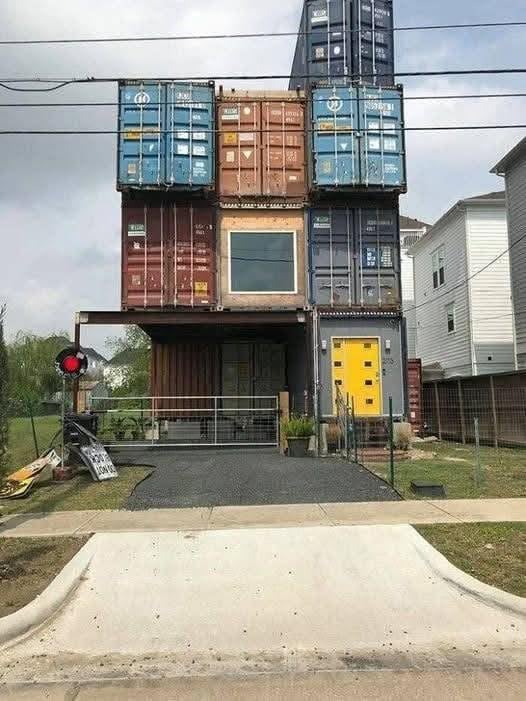
The first time the cranes appeared at the end of the street, people assumed there had been some kind of mistake. A construction company must have taken a wrong turn, they thought. That sort of equipment didn’t belong here, not in a quiet neighborhood where the loudest afternoon sound was usually a lawn mower or children riding bikes. But the cranes didn’t leave. Instead, they unfolded their massive arms over the narrow road, cables tightening as the first rusted shipping container rose slowly into the air.
Residents stepped onto their porches, squinting into the sunlight. Phones came out. Curtains twitched. No one quite understood what they were seeing.
Then the container swung over the street.
It hung there for a moment—an enormous steel box streaked with rust and faded paint—before lowering onto the empty lot at the corner. The metallic thud echoed through the block.
Within an hour, another arrived.
Then another.
Soon the sky above the neighborhood was filled with the groaning sound of cranes and the creak of steel cables. Shipping containers—old, battered relics from cargo ships—were being stacked one on top of another like oversized building blocks.
That’s when confusion turned into panic.
“What on earth are they doing?” one neighbor demanded from the sidewalk.
“This can’t be legal,” another muttered.
Word spread quickly through the block. By evening, a small crowd had gathered behind temporary fencing, watching welders spark bright blue flashes of light against the growing structure. Rumors moved faster than the cranes. Some said it would be a warehouse. Others swore it was going to be some kind of storage yard.
But when someone finally learned the truth, the reaction was even stronger.
It was going to be a house.
A house made entirely from shipping containers.
The gossip exploded.
At neighborhood barbecues and online message boards, people shook their heads in disbelief. They called it ugly. They called it reckless. A few even called it dangerous.
“It’s going to look like a junkyard,” one resident complained.
“Property values are going to plummet,” another insisted.
From the outside, it wasn’t hard to see why people were skeptical. The structure looked raw and unfinished for weeks. Stacked steel boxes, their paint chipped and scratched, formed a strange skeletal tower that seemed completely out of place among the tidy homes nearby.
To many residents, it felt like an invasion of industrial chaos.
They began referring to it mockingly as “the scrapyard house.”
But construction continued.
Day after day, welders sealed the seams where containers met, sparks flying like fireflies in the afternoon air. Workers cut enormous rectangular openings into the steel walls, shaping spaces where windows would eventually go. Panels of glass arrived. Insulation followed. Stairs were bolted into place, linking one container level to another.
Slowly, almost imperceptibly, the project began to change.
The sharp edges softened as clean lines emerged from the once-cluttered frame. The steel surfaces were restored and treated, their weathered textures becoming part of the design instead of something to hide.
Still, many neighbors remained unconvinced.
They waited for the moment it would collapse under its own absurdity.
But that moment never came.
Instead, one evening, after weeks of noise and speculation, the cranes disappeared. The welders packed up their equipment. The construction fence came down.
And the lights turned on.
For the first time, the neighborhood saw the finished home.
At night, the container house glowed.
Warm golden light spilled through tall, carefully cut windows that stretched from floor to ceiling. Behind the glass, you could see open spaces, polished floors, and minimalist interiors that looked more like a modern architectural magazine than the inside of an old cargo container.
The raw steel exterior, once dismissed as ugly, now framed the structure like an industrial sculpture.
What had been mocked as a pile of scrap suddenly looked bold. Intentional. Almost visionary.
Cars slowed as they passed.
People walking their dogs paused on the sidewalk, pretending to adjust their leashes while they stared a little longer than before.
The so-called “junkyard project” no longer looked like madness.
It looked like a statement.
Inside, the transformation was even more dramatic. Sunlight poured through the massive windows during the day, bouncing across smooth concrete floors and pale wooden surfaces. The containers, once cramped shipping units that crossed oceans carrying cargo, had been reimagined into airy living spaces.
High ceilings connected multiple containers together. Narrow steel corridors opened into bright communal rooms. Clean architectural lines allowed the industrial structure to remain visible, turning beams and welded joints into part of the aesthetic rather than something hidden behind drywall.
It felt surprisingly calm.
Peaceful, even.
Every container used in the house had been rescued from a scrapyard, given a second life instead of being melted down or abandoned. What once carried goods across oceans now carried something far more personal: the idea that a home could be strong, sustainable, and creatively built.
The project had become more than a house.
It had become a quiet argument about what homes could be in the future.
Gradually, the tone in the neighborhood began to change.
The whispers about the “crazy man on McGowen Street” faded.
Now people spoke differently.
They slowed their cars when passing the corner lot. They pointed out the tall glass walls to visiting friends. A few even walked by deliberately just to study the structure more closely.
The thing they once feared would ruin the neighborhood had done something unexpected.
It had made them curious.
And sometimes, standing there under the warm glow of the container house at night, neighbors found themselves wondering something they never expected to think:
What if the strange idea they laughed at… was actually brilliant all along? ✨🏡