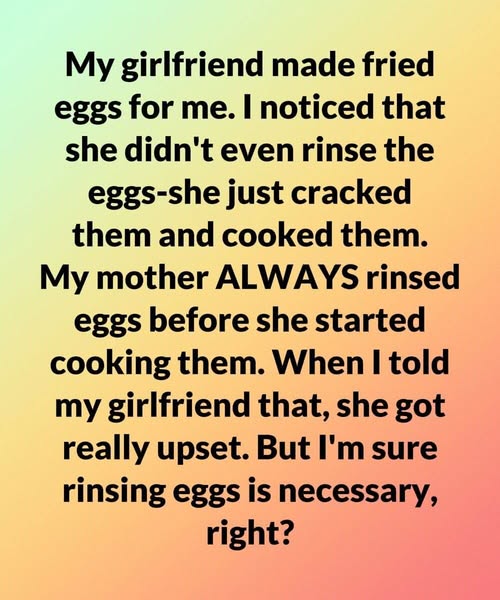
Every love story carries a quiet risk—the kind that doesn’t announce itself with shouting or storms, but slips in through ordinary moments that suddenly feel heavier than they should.
For Mira and Evan, it started on a slow morning that felt almost too peaceful to suspect anything could go wrong. Sunlight poured into their small kitchen in soft golden streaks, dust drifting lazily through the air. The smell of breakfast filled the room—warm eggs, melted butter, the comforting promise of something simple made with care. It should have been one of those memory-like moments people look back on and smile at without effort.
But love, in its most fragile form, can turn on something as small as a sentence.
Evan leaned against the counter, watching her cook with a quiet ease he’d come to rely on. Mira moved with focus and intention, as if the breakfast she was preparing mattered more than just food—it was her way of saying I care. She had woken up early, long before he stirred, wanting to do something kind without needing a reason. A gesture without expectation. A love language spoken in heat, salt, and patience.
Then Evan, half-distracted, half-lost in memory, spoke.
“Did you wash the eggs first?”
It was not meant to wound. Not even close. To him, it was a casual echo of something he remembered from childhood, something his mother used to insist on in their own kitchen years ago. A harmless comparison. A passing thought spoken out loud.
But in that quiet kitchen, the words landed differently.
Mira’s hand paused mid-motion.
The sound of the pan—soft crackling, familiar and warm—suddenly felt too loud against the silence that followed. Something in her posture changed almost instantly, though she didn’t turn around. The warmth in her movements cooled, not because the food had changed, but because something inside her had.
To her, the question didn’t sound like curiosity.
It sounded like evaluation.
Like her effort had been measured and found lacking.
Like the breakfast she had prepared with care was suddenly being compared to a version of “better” she was never told she was supposed to match.
And worst of all—it wasn’t just about eggs.
It was about everything unspoken beneath it. The invisible comparisons. The quiet fear of not being enough in a home she was trying so hard to build love inside.
Her voice, when it finally came, was careful.
“I didn’t know I had to.”
The words weren’t sharp. They were restrained. That made them heavier.
Evan frowned slightly, sensing the shift but not yet understanding it. The kitchen that moments ago had felt soft and familiar now felt like it had edges. Invisible ones, but sharp all the same.
“I didn’t mean—” he started, then stopped. Because he didn’t actually know what he meant anymore.
The eggs kept sizzling. The butter kept melting. Life, on the surface, continued exactly the same. But something between them had tilted.
For the rest of the morning, they moved around each other like careful strangers sharing a small space. Not angry enough to argue. Not close enough to feel normal. Just suspended in that uncomfortable place where love hasn’t broken—but has been questioned.
It wasn’t until later that day that the truth began to unravel.
That evening, when the house had quieted and the weight of the day had settled into softer edges, Evan finally sat beside her. Not across from her. Not standing. Beside her. As if reducing the distance between them might also reduce the misunderstanding.
“I think I said something wrong this morning,” he admitted.
Mira didn’t look up immediately. She was still holding onto the memory of how easily her care had felt misunderstood.
“It wasn’t about eggs,” she said at last.
That was the beginning.
Slowly, carefully, what had felt like tension began to turn into something else entirely—something more vulnerable. Mira explained how the question made her feel judged, like she had been placed against an invisible standard she didn’t know she was being measured by. Evan listened, and for the first time, he didn’t try to fix it right away. He just listened.
And then he shared what he meant—how the question wasn’t correction, but recollection. A memory of his childhood kitchen. His mother. A habit he never questioned until it came out in the worst possible way.
Silence returned, but this time it wasn’t cold.
It was understanding taking shape.
In that quiet exchange, they began to see something neither of them had named before: every reaction they had wasn’t just about the present moment. It carried echoes of everything they had lived before meeting each other.
Her need to feel seen. His habit of remembering through comparison. Two different histories, briefly colliding over something as ordinary as breakfast.
And yet, instead of letting that collision become a fracture, they chose something harder.
Curiosity instead of defense.
Softness instead of pride.
Mira finally exhaled, not in surrender, but in release. Evan reached for her hand—not to correct, not to explain further, but simply to be there.
What happened in that kitchen wasn’t just a misunderstanding about eggs.
It was a quiet turning point.
Because in learning to name what hurt, and to ask what was meant, they didn’t just repair a single morning—they reshaped the way they would love each other in all the mornings still to come.