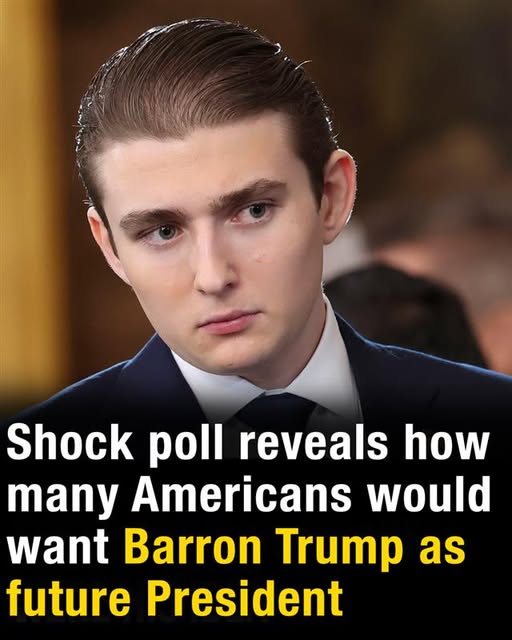
A single question—simple on its surface, almost speculative in tone—has rippled through the political world with surprising force. It wasn’t about policy, or elections, or even the current balance of power. It was about the future. More specifically, it was about Barron Trump—and whether the rules that govern the presidency itself should bend to accommodate a name that already carries enormous weight.
The question posed to Republican voters was as bold as it was unexpected: would they support rewriting the U.S. Constitution to allow Donald Trump’s youngest son to run for president before reaching the constitutionally mandated age of 35?
What came back wasn’t a dismissal. It wasn’t outrage. It was something far more revealing.
The numbers stunned analysts. Roughly 40 percent of Republican respondents said they would at least consider changing the Constitution to make such a scenario possible. Even more striking, nearly half said they could envision Barron Trump becoming president through the normal process—no amendments required. For a 20-year-old college student who has never held public office, never campaigned, and rarely speaks publicly, that level of support is almost unprecedented in modern American politics.
But beneath those numbers lies something deeper than curiosity about a famous last name. This isn’t just about Barron. It’s about legacy.
Within the Republican base, there is a growing sense that the political movement shaped by Donald Trump is not just a moment—it’s a force that should endure. And when movements seek longevity, they often look toward continuity. Names become symbols. Symbols become vehicles. And suddenly, the idea of a political dynasty—once dismissed as unlikely in American democracy—begins to feel less far-fetched.
Barron Trump, despite his low profile, has quietly become part of that conversation. Reports and insiders have suggested that he has played a subtle role behind the scenes, particularly in helping his father understand and navigate platforms that resonate with younger audiences. His awareness of Gen Z culture, combined with a natural curiosity about media and communication, has sparked intrigue among younger conservatives who see in him a bridge between generations.
That intrigue is turning into something more powerful: projection.
Supporters aren’t just observing who Barron is—they’re imagining who he could become. A businessman? A private figure? Or something far more consequential—a future candidate stepping onto a stage already built, already electrified, already waiting for a familiar name to return.
Of course, the constitutional barrier remains clear. The presidency has long required candidates to be at least 35 years old, a safeguard designed to ensure experience and maturity at the highest level of leadership. Changing that would not only be difficult—it would be historic, requiring overwhelming political will across a deeply divided system.
And yet, the fact that such a question is being asked—and seriously entertained—signals a shift in how political loyalty, identity, and succession are being viewed in America.
This is no longer just about one election cycle, or even one presidency. It’s about the possibility of a generational handoff, a continuation of influence that stretches beyond a single figure and into something more enduring.
Barron Trump has not declared any ambitions. He has not entered the arena. But in the minds of many, the outline of a future is already taking shape.
And whether that future ever materializes or not, one thing is now unmistakably clear: for a significant portion of the electorate, the idea of seeing “Barron Trump” on a presidential ballot is no longer hypothetical.
It’s imaginable.