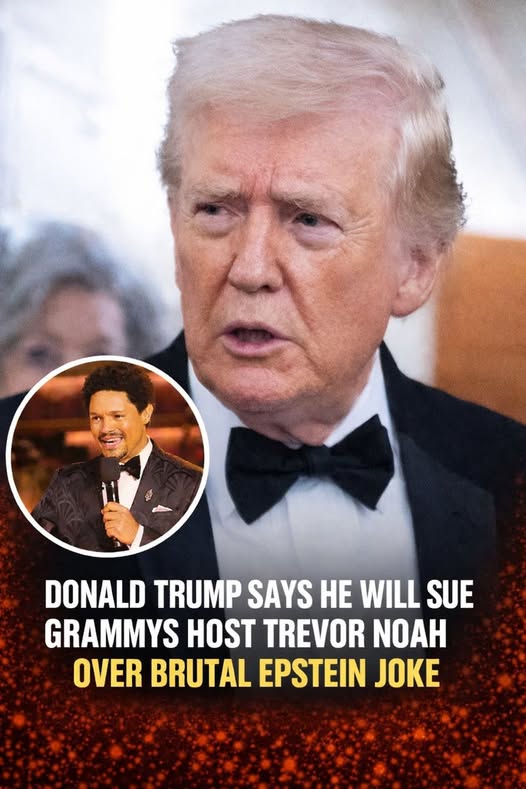
It started with a single punchline — quick, sharp, and delivered on live television — and it may end in a courtroom showdown. Donald Trump has erupted in fury after Trevor Noah aimed a joke his way during the Grammys, a crack referencing Jeffrey Epstein that sent a visible ripple through the audience. Now, the former president is threatening legal action, promising to haul the comedian into court over what he calls a “false and defamatory” smear. Lawyers are circling, Truth Social is ablaze, and newly unsealed Epstein-related documents are pouring gasoline on an already raging fire.
At the center of the storm is a familiar and combustible mix: political power, celebrity satire, and one of the darkest scandals in modern American history. Noah’s quip — suggesting Trump might be “in the market for a new island” — landed at a moment when public attention was already locked onto thousands of pages of Epstein files, documents that mention Trump’s name repeatedly while reigniting long-simmering suspicions and speculation. Though no criminal charges have emerged from those mentions, the timing turned a joke into a flashpoint.
Trump’s reaction was swift and explosive. In a blistering online rant, he accused Noah of spreading lies, dismissed the joke as malicious propaganda, and vowed to sue for “plenty $$$.” The response underscored how thin the line can be between satire and perceived slander — especially when reputations are under relentless pressure and every headline feels like an attack.
The Grammys stage, of course, has long been a magnet for controversy. It’s a place where performers and hosts test the limits of free speech, poke at powerful figures, and force uncomfortable conversations into the spotlight. Comedy, at its best, exposes tension; at its riskiest, it dares those in power to respond. This time, the response came not as a rebuttal, but as a legal threat.
Meanwhile, federal officials maintain that the most explosive allegations circulating online are “unfounded and false,” urging caution amid a flood of speculation and half-read documents. Still, the spectacle feels all too familiar: a powerful man threatening legal warfare over a joke, a comedian standing by satire as social commentary, and a public left to sift through noise, outrage, and unanswered questions.
The real question lingering over the clash isn’t just who crossed a line — it’s why a single joke struck such a nerve, and what it reveals about the uneasy intersection of comedy, accountability, and power in an era where every laugh can echo far beyond the stage.