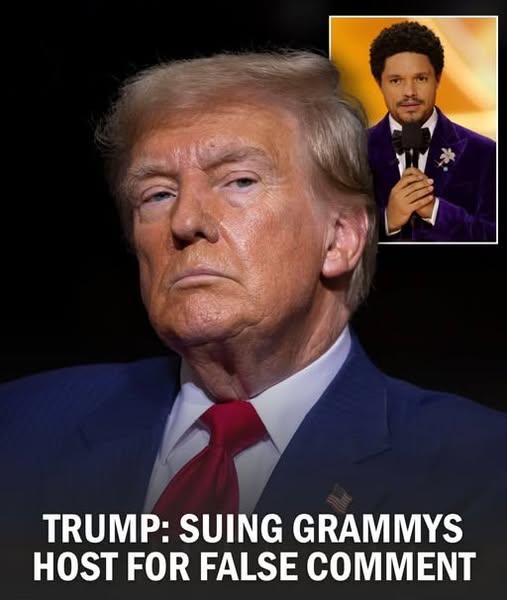
The laughter barely had time to fade before the mood shifted. On what was supposed to be Hollywood’s most glittering, self-congratulatory night, a single punchline cracked the room—and then ricocheted far beyond it. In a matter of hours, a throwaway joke from the Grammy Awards stage ignited a political inferno, pulling Donald Trump, Trevor Noah, and the ghost of Jeffrey Epstein into the same explosive frame.
Trump’s reaction was immediate and volcanic. Taking to Truth Social, he accused the Grammy host of crossing a line that comedians are rarely forced to defend in court: transforming satire into what he called a devastating lie. According to Trump, Noah’s remark falsely linked him to Epstein’s notorious private island, a place synonymous with one of the darkest scandals in modern American history. This was not, he insisted, “just a joke.” It was an attack—deliberate, defamatory, and designed to stain his name.
Suddenly, the familiar rituals kicked in. Political allies closed ranks. Media figures chose sides. Lawyers’ names began to circulate, not hypothetically, but seriously. Trump’s team signaled that this time the response would go beyond outrage posts and press statements. They were prepared, they said, to take the fight into a courtroom, challenging not only the joke itself but the broader assumption that comedy enjoys unlimited protection when it echoes real-world accusations.
At the heart of the controversy was Noah’s quip, which tied Trump’s past musings about acquiring Greenland to the idea of “finding a new island to hang out with Bill Clinton”—a line that deliberately brushed against the Epstein scandal without naming it outright. The audience laughed. The cameras moved on. But the implication lingered, sharp and unmistakable.
The problem, critics quickly pointed out, is that implication can sound a lot like allegation. No evidence has ever surfaced showing that Trump visited Epstein’s Caribbean property, and even media outlets openly hostile to him have stopped short of making that claim. Trump seized on that absence of proof, framing the joke as not merely tasteless but knowingly false—an example, he argued, of character assassination disguised as late-night humor.
As Trump’s allies blasted Noah and accused him of “irresponsible political theater,” the episode exposed a deeper, unresolved tension in American culture. Comedy has long served as a weapon against power, protected by free speech and public appetite for irreverence. But when a joke closely mirrors a factual accusation—especially one tied to criminal infamy—where does satire end and defamation begin?
What started as a fleeting moment of televised humor has now become something far heavier: a national argument over truth, reputation, and the cost of laughter in an age where every word can echo forever.