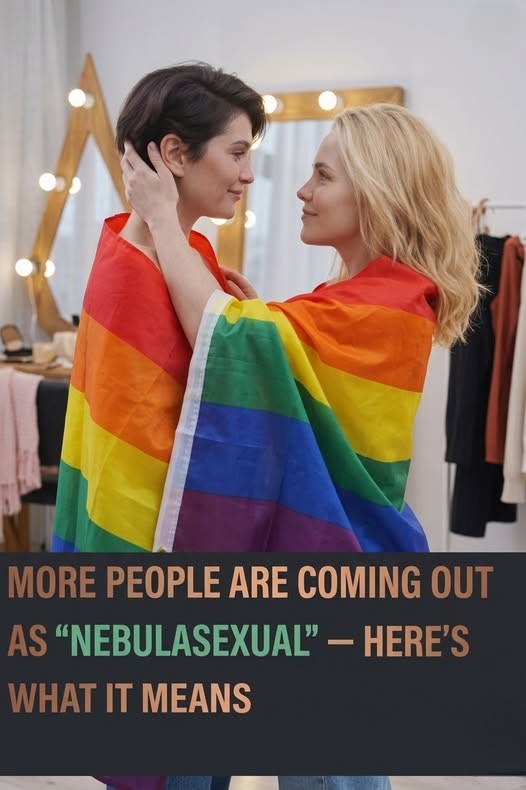
Some people don’t just question their sexuality—they experience it as something that refuses to stay still. It slips through their fingers, resists definition, and reshapes itself the moment they try to understand it. For them, attraction isn’t a clear signal pointing in a direction; it’s more like fog—thick, shifting, impossible to map. In recent years, the word “nebulasexual” has emerged as both a refuge and a flashpoint. It has become a term that comforts and unsettles in equal measure, offering clarity to some while provoking skepticism in others. Yet behind this single word lies something much deeper: a complex landscape of identity, uncertainty, and the human need to be understood.
For those who resonate with nebulasexuality, attraction does not arrive as a clean “yes” or “no.” It exists instead as a subtle, ever-changing haze. They might long for intimacy, connection, or companionship, yet struggle to pinpoint what exactly they feel. Is it romantic? Sexual? Emotional? Aesthetic? Or something that doesn’t quite fit any of these categories? The lines blur until the categories themselves start to feel inadequate. What others experience as distinct forms of attraction becomes, for them, an overlapping spectrum with no clear boundaries.
This isn’t mere confusion, nor is it a phase waiting to be resolved. It is an ongoing state of being—a lived experience where certainty is rare and ambiguity is constant. For many, especially those who are neurodivergent, this ambiguity is intensified by the way their minds process emotion, thought, and sensation. Intrusive thoughts can mimic desire. Hyperfixations can feel like love. Emotional closeness can exist without any accompanying label. In such a landscape, traditional definitions of attraction don’t just fall short—they can feel alien.
The term nebulasexual offers something that was missing for a long time: language. And language matters. It provides a mirror where previously there was only distortion, a way to articulate experiences that once felt isolating and inexpressible. To finally have a word that says, “this too exists,” can be profoundly validating. It doesn’t solve the ambiguity, but it makes it visible—and visibility can be its own kind of relief.
At the same time, the rise of this term has sparked criticism. Some view it as unnecessary, another addition to an already expanding vocabulary of identity labels. To them, it may seem like fragmentation—an overcomplication of something that should be simple. But this perspective often overlooks the lived reality behind the label. For those who identify with nebulasexuality, the term isn’t about categorizing for the sake of it; it’s about survival in a world that expects clarity where none exists.
More than anything, nebulasexuality names a specific kind of struggle: the feeling of not fitting into established frameworks, of constantly questioning your own experiences, of lacking the words to explain yourself to others—or even to yourself. And in naming that struggle, it does something quietly powerful. It affirms that even the most indistinct, fluid, and uncertain experiences of attraction are still valid. They are still human. They still deserve recognition, understanding, and respect.
Because not all identities are sharp-edged and easily defined. Some are soft, shifting, and hard to hold onto. And that doesn’t make them any less real—it simply makes them harder to see.