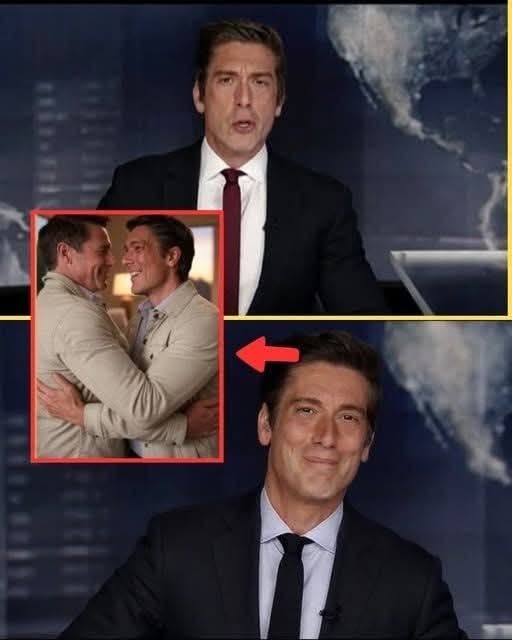
The words seemed to lodge in his throat as he stood before the nation, heavy with everything they carried. David Muir—still recovering from surgery, his body not yet whole—finally chose to speak after days of silence. What followed was not the carefully measured cadence viewers expect from a seasoned anchor, but something far more human. And when he opened the door to Michael Strahan’s private heartbreak—his daughter’s devastating diagnosis and the impossible decision to share that pain in front of millions—it left even longtime viewers stunned.
This was not simply an update. It was a moment of reckoning.
Muir spoke not as the unflappable face of the evening news, but as a man newly acquainted with his own vulnerability. He admitted, with disarming honesty, that healing is rarely linear. The road ahead, he said, feels long, uncertain, and at times deeply frightening. Strength, in this season, has not come from certainty or control, but from three quiet anchors: love, a sense of purpose, and the unseen but deeply felt presence of millions of prayers whispered by people he may never meet.
That same empathy carried him toward his colleague and friend, Michael Strahan. Muir spoke of Strahan not as a celebrated public figure, but as a father walking through every parent’s worst nightmare. His daughter Isabella’s battle with medulloblastoma, he noted, has demanded a courage that cannot be rehearsed or broadcast-ready—a courage forged in hospital rooms, long nights, and moments no camera ever captures.
Muir did not shy away from naming the brutal dilemma faced by those in the public eye: how much of one’s deepest suffering can—or should—be shared with an audience that has been conditioned to see them as invincible. In honoring Strahan’s choice to let the world see his fear, his grief, and his hope, Muir reframed vulnerability itself. This, he suggested, is not weakness. It is a rare and powerful form of leadership—one that gives others permission to be honest about their own pain.
In that moment, their parallel struggles—one man healing from surgery, another standing steadfast beside a child in crisis—merged into something larger than either story alone. It became a reminder that even the strongest among us are not self-made, nor self-sustaining. We endure because we are held—by family, by faith, by colleagues, and by strangers who offer compassion from afar.
What the audience witnessed was not just news. It was a quiet testament to resilience, humanity, and the unspoken truth that strength is often born not in triumph, but in the courage to be seen when we are most fragile.