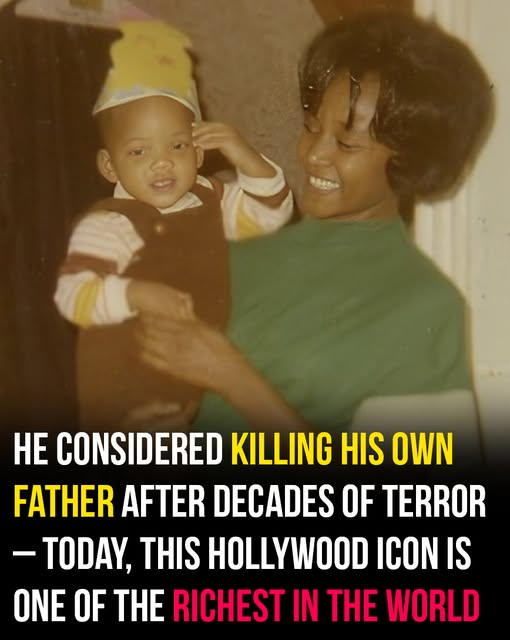
The truth about Will Smith’s past is far more harrowing than the effortless smile and box-office charisma the world has come to know. Long before the red carpets, the sold-out premieres, and the standing ovations, there was a terrified little boy standing in his own home, frozen in place, watching his mother bleed. He watched her spit blood onto the floor after another beating from the man who was supposed to protect them. That image didn’t fade with time—it calcified. It became part of him.
Smith has spoken openly about the deep contradiction at the center of his childhood: he adored his father, and he feared him just as deeply. His father was strong, disciplined, and commanding—a man who believed love was forged through control. To a young Will, that strength was intoxicating and terrifying all at once. He learned early that silence could be a form of survival. At just nine years old, he stood powerless, unable to intervene, and that helplessness carved a quiet, lifelong vow into his heart: I will never be that weak again.
Years later, as an adult, that vow still echoed. Smith has revealed that at one point, during his father’s final years, he stood at the top of a staircase and imagined pushing him down—an intrusive, frightening thought born not of cruelty, but of unresolved rage and pain. It was a moment that forced him to confront just how deep those childhood wounds ran, and how success, fame, and wealth had never truly erased them.
Will Smith’s life, in many ways, is a study in contradictions. He is a man shaped by violence who became obsessed with protection. A global superstar whose confidence masks a boy still haunted by the silence of his younger self. His father’s iron-fisted version of love left a wound so deep that no blockbuster role or award could ever fully cauterize it. Every joke, every heroic character, every triumphant acceptance speech carried something unspoken beneath it—a quiet apology to his mother, and an ongoing plea for his own redemption.
But the defining moment wasn’t the imagined fall down the stairs. It was the choice not to act on it. In that restraint, Smith rewrote his story. He chose care over revenge. Presence over dominance. Compassion over control. In doing so, he broke a generational cycle that had once seemed inevitable.
As a father, Will Smith made a deliberate vow to be different. He rejected the drill-sergeant model of parenting he grew up with and embraced what he calls being a “gardener”—nurturing, observing, and allowing each child to grow into who they are meant to be. With Trey, Jaden, and Willow, he sought not obedience, but understanding. Not fear, but trust. It was a radical shift born directly from his pain.
Then came the Oscars slap—a moment the world witnessed in real time. To many, it was shocking and confusing. To Smith, it was something else entirely: the resurfacing of a rage he thought he had mastered. That single act forced him to confront the part of himself still driven by that nine-year-old boy’s vow to protect at all costs. Painfully and publicly, he had to reckon with the truth that healing is not linear, and that unaddressed trauma does not disappear simply because life looks successful on the outside.
Today, Will Smith’s journey is no longer about outrunning his past or performing perfection for the world. It’s about learning to live honestly with what shaped him—acknowledging the darkness without letting it define him. His story is not one of a fallen star, but of a deeply human man still doing the hardest work there is: breaking cycles, choosing love over fear, and learning, one painful step at a time, how to be whole.