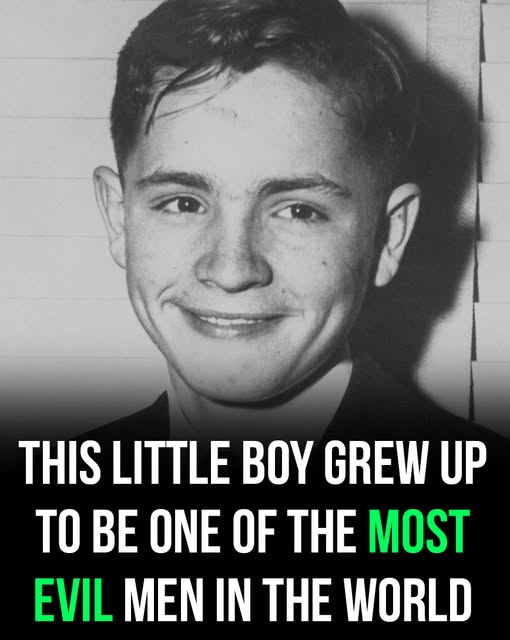
He entered the world already unwanted, a child passed from hand to hand like an inconvenience no one planned to keep. There was no soft landing, no steady voice promising safety. Instead, there were bruises that went unexplained, doors that slammed shut and stayed that way, and long nights marked by the certainty that no one was coming back for him. By the time society found the language to label him “dangerous,” the damage had been etched deep into his bones. Teachers learned to avert their eyes. Social workers ran out of patience. Judges reduced a fractured childhood to a checklist. Prisons did what they so often do: they took a broken boy and finished breaking him into something harder, colder, and far more frightening.
Charles Manson’s childhood was not a single catastrophe but a slow, grinding collapse stretched across years. It was a life shaped by rejection and neglect, where affection was rare and always temporary, and authority figures appeared only to punish or disappear. He learned early that attachment was a liability and that vulnerability invited pain. In a world where nothing was stable, control became his only sense of security. Survival meant learning people the way others learn tools—how to use them, how to manipulate them, how to stay one step ahead of abandonment.
The institutions meant to “fix” him never addressed the wound at the center. Reform schools and juvenile facilities did not teach empathy or accountability; they taught performance. They taught him how to read a room, how to charm when charm was useful, how to intimidate when it wasn’t. Behind bars, he refined the art of becoming whatever others wanted to see. Each sentence handed down was less a punishment than a training exercise, sharpening the skills that would later make him so dangerous. By the time he emerged into the chaos of the 1960s counterculture, he was uniquely prepared to exploit it.
To a generation disillusioned with authority and desperate for meaning, Manson offered something intoxicating: belonging. He spoke in borrowed fragments of love, freedom, and spiritual awakening, wrapping domination in the language of peace. He positioned himself as a guide, a prophet, a father figure to the lost and searching. In reality, he was building a hall of mirrors, surrounding himself with followers trained to reflect his darkest impulses back to him as devotion. What looked like community was control. What sounded like enlightenment was obedience.
The crimes that later horrified the world did not erupt out of nowhere. They were not lightning strikes of sudden madness or inexplicable evil. They were the grim endpoint of a life twisted from its very beginning, shaped by neglect, reinforced by failed systems, and unleashed at exactly the wrong cultural moment. Understanding that does not excuse what he did—but it does strip away the comforting myth that monsters are simply born, fully formed, and unpreventable.
Manson’s legacy leaves us with an unsettling question that refuses to go away: how many children are being quietly damaged right now, passed through indifferent systems, mislabeled instead of helped, punished instead of healed? And how many future disasters are being assembled in plain sight, not by fate or destiny, but by our collective willingness to look away?