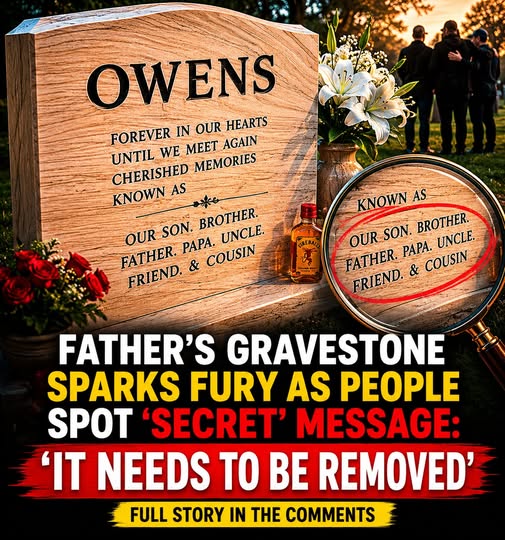
The outrage didn’t begin with a headline. It began with a whisper drifting through the quiet rows of an Iowa cemetery. One visitor noticed something strange etched into the memorial. Then another person looked closer. Soon, word spread beyond the gates of Warren-Powers Cemetery, transforming an otherwise peaceful burial ground into the center of a bitter national debate. What some saw as a harmless private tribute, others condemned as a shocking insult carved permanently into stone.
At first glance, the headstone appears ordinary—gray, weathered, and almost indistinguishable from the countless others standing beneath the fading Midwestern sky. Families pass by carrying flowers, children’s voices fade into the distance, and the wind moves softly through the grass. But for those who pause long enough to read the inscription carefully, a hidden message slowly reveals itself.
The back of the stone reads like a traditional farewell:
“Forever in our hearts.
Until we meet again…”
Yet the first letter of every line forms an acrostic—one that secretly spells out a crude phrase that Steven Owens often joked with his loved ones. To outsiders, it feels offensive and inappropriate. To his family, however, it represents something entirely different. It is not vulgarity. It is memory. It is personality preserved in granite. It is the echo of a father laughing across a kitchen table, pretending to be irritated before breaking into a grin moments later.
His children say the phrase was part of who he was. It was how he teased the people he loved most, a strange but familiar expression woven into everyday family life. In their eyes, removing the hidden message would erase something deeply human about him. Grief, after all, is not always polished or poetic. Sometimes love sounds messy. Sometimes remembrance comes wrapped in humor that outsiders will never fully understand.
But cemeteries are not private spaces. They are shared landscapes of mourning, where strangers grieve side by side. And that is where the conflict began.
Township trustees and community members argue that personal expression has limits when placed in public view. They worry about the unsuspecting visitor kneeling beside a nearby grave, only to suddenly notice the hidden profanity embedded within the memorial. What should a cemetery represent—individual freedom, or collective respect? Can one family’s intimate joke coexist with another family’s search for peace and dignity?
The controversy quickly spread far beyond Iowa. Online debates erupted as people chose sides. Some defended the Owens family, calling the headstone a touching reflection of authenticity and personality. Others viewed it as deeply disrespectful, arguing that cemeteries should remain sacred spaces free from hidden obscenities. What made the debate even more powerful was the fact that the message wasn’t immediately visible. It lingered there quietly, concealed in plain sight, waiting for observant eyes to uncover it.
Years later, the stone still stands.
The acrostic remains untouched, silently challenging every passerby who notices it. Some laugh. Some shake their heads in anger. Others stare at it longer than they expected, wondering why a simple arrangement of letters can provoke such discomfort. Perhaps the real reason the memorial continues to spark outrage is because it forces people to confront an uncomfortable truth about grief itself: love is rarely neat, respectful, or universally acceptable.
As evening settles over Warren-Powers Cemetery and the shadows stretch across the rows of graves, the hidden message remains frozen in stone—a final joke from a man remembered imperfectly, honestly, and fiercely by the people who loved him most. And with every new visitor who discovers it, the same difficult question rises again:
Where does respect end when remembrance refuses to behave?