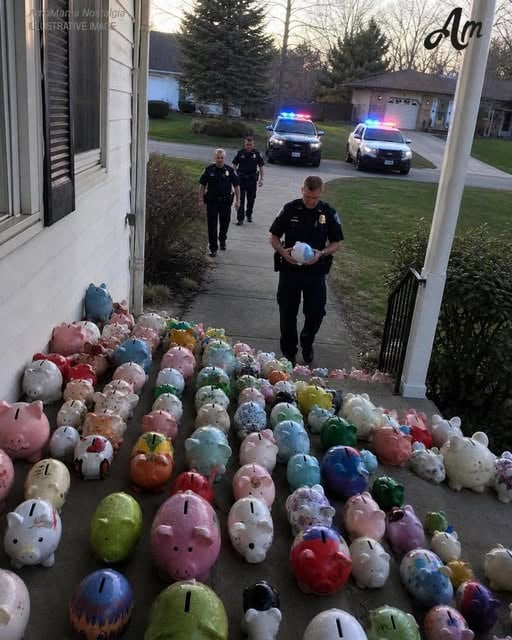
The sirens didn’t scream through our neighborhood because someone had been robbed, attacked, or arrested. They came for something far smaller. Something almost invisible. A six-year-old boy standing on a front porch, clutching a chipped ceramic piggy bank against his chest like it contained the weight of the world.
At the time, none of us understood that those flashing red-and-blue lights would expose a secret our entire town had spent years overlooking.
It started with a dark porch at the end of Maple Street.
Mrs. Adele Carter had lived there for as long as anyone could remember. The kind of woman who never missed a school fundraiser, who somehow always appeared with casseroles after funerals, knitted scarves in winter, and handwritten birthday cards no matter how old you got. She was woven into the fabric of this town so completely that we stopped seeing her as a person and started seeing her as something permanent—like the church bell or the old oak tree near the post office.
And maybe that was the problem.
Permanent things become invisible.
That evening, my son Oliver noticed before anyone else did.
“Why are Miss Adele’s lights off?” he asked from the backseat as we drove home.
I barely glanced toward the house. “Maybe she went to bed early.”
But he kept staring through the window.
“No,” he whispered. “It feels sad.”
Children notice things adults train themselves to ignore.
The next morning, Oliver disappeared into his room while I made coffee. A few minutes later, he returned carrying his piggy bank—the blue one shaped like a dinosaur, covered in cracks from years of being dropped on kitchen floors.
“I need help breaking it,” he said.
I laughed softly. “Why?”
He looked at me like the answer should have been obvious.
“Miss Adele needs her lights back.”
I wish I could tell you I immediately understood the importance of that moment. I didn’t. I was distracted, running late, mentally drowning in bills, schedules, emails, and all the exhausting little emergencies adulthood stacks on your shoulders until compassion becomes another thing you promise to get to later.
But Oliver stood there stubbornly, tiny fists wrapped around that dinosaur bank, refusing to move.
So I grabbed a hammer.
Coins exploded across the counter—quarters, dimes, sticky dollar bills folded so tightly they looked ancient. Birthday money. Tooth fairy money. Lemonade stand money. The entire economy of a six-year-old child spilled into a pile beside the coffee maker.
Eighty-seven dollars and forty-three cents.
Oliver smiled proudly. “That should help.”
I drove him to Adele’s house mostly to teach him a lesson about kindness, never imagining he was about to teach one to me instead.
When Adele opened the door, the house behind her was nearly dark except for weak daylight filtering through faded curtains. No television. No humming refrigerator. No lamps. Just silence.
The kind of silence poverty creates.
She looked embarrassed before we even spoke.
Oliver stretched out both hands toward her, offering every penny he owned.
“I think your lights went out,” he said gently. “So I brought my money.”
Adele covered her mouth and started crying.
Not the polite kind of tears adults apologize for.
The kind that come from being exhausted for too long.
That was when we learned the truth.
Her pension had been delayed for months. Medical bills had swallowed what little savings she had left. Her electricity had been shut off three days earlier. Her fridge was empty except for mustard packets and bread heels. And somehow—through all of it—she had still been volunteering at the church pantry every Thursday, still smiling at neighbors, still asking everyone else how they were doing.
Because some people become so used to carrying others that they forget they’re allowed to ask for help themselves.
Oliver hugged her without hesitation.
And something inside me broke.
By evening, the story had spread across town.
Not because anyone wanted attention. Because people were horrified.
The first patrol car arrived after one of the officers heard what happened at the diner. Then another came. Then a local electrician parked outside and quietly restored power free of charge. Teachers showed up carrying groceries. Former students arrived with envelopes. A mechanic handed over gift cards. Someone brought a new heater. Someone else paid six months of utilities in advance.
By midnight, our lawn looked like the center of a parade route.
Neighbors stood in clusters under flashing lights, trading stories about Adele.
“She used to buy winter coats for kids anonymously.”
“She paid my lunch debt in seventh grade.”
“She brought my husband dinner every week after surgery.”
“She helped my mom learn to read.”
One by one, people realized the same terrifying thing:
The woman we had all failed to notice had been quietly holding up half the town for decades.
And none of us had asked whether she was okay.
The next morning, more piggy banks appeared.
Children arrived carrying jars of coins and wrinkled bills. Teenagers handed over allowance money. Elderly couples dropped house keys on the table, offering spare rooms if Adele ever needed them. Every donation felt less like charity and more like an apology.
A confession wrapped in kindness.
“You mattered to us.”
“We should’ve seen sooner.”
“Thank you for carrying us.”
By the time the final piggy bank was opened, the story wasn’t really about unpaid bills anymore. It wasn’t even about a shut-off notice or a forgotten woman sitting alone in the dark.
It had become something bigger.
A mirror.
Because the truth is, most communities don’t collapse all at once. They fade slowly, every time people decide they’re too busy to check on one another. Every time we assume someone else will help. Every time convenience becomes more important than connection.
Watching Oliver press his tiny hand into Adele’s trembling one, I realized what frightened me most wasn’t poverty or failing systems or overdue bills.
It was how easy it had become for all of us to look away.
How casually we let “busy” become permission to abandon the very people who once carried us through our hardest moments.
That morning, we didn’t just turn Adele’s lights back on.
We reignited something in ourselves.
Something we hadn’t realized was dying.
And as strangers filled the street, as laughter replaced silence, as porch lights glowed warm against the dawn, I understood one final thing:
Kindness is contagious.
It spreads quietly at first. One small act. One child. One broken piggy bank.
And before anyone realizes it, an entire town remembers how to care again.